Implementasi Teknik Emotional Demostration dalam Pemberdayaan Kader Kesehatan Peduli Stunting

https://doi.org/10.33860/pjpm.v7i3.3758
Keywords:
emotional demonstration, kader, stuntingAbstract
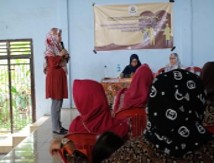
Prevalensi stunting di Kabupaten Ogan Komering Ilir Provinsi Sumatera Selatan termasuk Kecamatan S.P Padang melebihi angka 20%. Sehingga Organisasi Kesehatan Dunia (WHO) mengkategorikannya sebagai permasalahan kesehatan masyarakat. Kegiatan ini bertujuan untuk mengimplementasikan teknik emotional demonstration dalam memberdayaan kader kesehatan yang peduli stunting. Sasaran dalam kegiatan ini adalah kader kesehatan aktif sebanyak 12 orang. Peserta diedukasi menggunakan metode emotional demonstration dengan simulasi/role play melalui games dan simulasi seperti, Menyusun balok, jadwal makan, cemilan sehat dan porsi makan dilanjutkan dengan diskusi interaktif. Pengetahuan responden dianalisis perubahannya sebelum dan setelah dilakukan edukasi. Analisis dilakukan menggunakan uji t dependent yang menunjukkan peningkatan secara signifikan sebesar 1,15 poin untuk hasil rata-rata pengetahuan (p-value = 0,002). Upaya edukasi menggunakan metode emotional demonstration melalui games interaktif dinilai efektif meningkatkan pengetahuan kader Kesehatan terkait upaya pencegahan stunting.
References
Aunger, R., & Curtis, V. (2016). Behaviour Centred Design: Towards an Applied Science of Behaviour Change. Health Psychology Review, 10(4), 425–446. https://doi.org/10.1080/17437199.2016.1219673
Black, R. E., & Heidkamp, R. (2018). Causes of Stunting and Preventive Dietary Interventions in Pregnancy and Early Childhood. Nestle Nutr Inst Workshop Ser, 89(1), 105–113. https://doi.org/10.1159/000486496
Camelia, V. (2020). Hubungan Antara Kualitas & Kuantitas Riwayat Kunjungan Antenatal Care (ANC) Dengan Stunting Pada Balita Usia 24-59 Bulan Di Kecamatan Pujon Kabupaten Malang. Journal of Issues in Midwifery, 4(3), 100–111. https://doi.org/10.21776/ub.JOIM.2020.004.03.1
Dibley, M. J., Alam, A., Fahmida, U., Ariawan, I., Titaley, C. R., Htet, M. K., … Ferguson, E. (2020). Evaluation of a Package of Behaviour Change Interventions (Baduta Program) to Improve Maternal and Child Nutrition in East Java, Indonesia: Protocol for an Impact Study. JMIR Research Protocols, 9(9), e18521-37. https://doi.org/10.2196/18521
GAIN Indonesia. (2017). Annual Report 2015-2016. Jakarta. Retrieved from https://www.gainhealth.org/sites/default/files/annual_reports/annual-report-2015-2016.pdf
Hall, C., Syafiq, A., Crookston, B., Bennett, C., Hasan, M. R., Linehan, M., … Dearden, K. (2018). Addressing Communications Campaign Development Challenges to Reduce Stunting in Indonesia. Health, 10(12), 1764–1778. https://doi.org/10.4236/health.2018.1012133
Kementerian Kesehatan Republik Indonesia. (2018). Laporan Riset Kesehatan Dasar Tahun 2018. In Badan Penelitian dan Pengembangan Kesehatan Kementerian Kesehatan Republik Indonesia. Jakarta: Kementerian Kesehatan Republik Indonesia. Retrieved from Kementerian Kesehatan Republik Indonesia website: http://labdata.litbang.kemkes.go.id/images/download/laporan/RKD/2018/Laporan_Nasional_RKD2018_FINAL.pdf
Khan, S., Zaheer, S., & Safdar, N. F. (2019). Determinants of Stunting, Underweight and Wasting among Children < 5 Years of Age: Evidence from 2012-2013 Pakistan Demographic and Health Survey. BMC Public Health, 19(1), 1–15. https://doi.org/10.1186/s12889-019-6688-2
Lestari, E. D., Hasanah, F., & Nugroho, N. A. (2018). Correlation between Non-Exclusive Breastfeeding and Low Birth Weight to Stunting in Children. Paediatrica Indonesiana, 58(3), 123–127. https://doi.org/10.14238/pi58.3.2018.123-7
Millward, D. J. (2017). Nutrition, infection and stunting: The roles of deficiencies of individual nutrients and foods, and of inflammation, as determinants of reduced linear growth of children. Nutrition Research Reviews, 30(1), 50–72. https://doi.org/10.1017/S0954422416000238
Nurhasanah, N., Rachmawati, D. A., & Sutejo, I. R. (2021). Defisit Berat Asupan Energi dan Protein Berhubungan dengan Stunting pada Anak Usia 12-24 Bulan di Desa Plerean, Sumberjambe, Jember. Journal of Agromedicine and Medical Science (AMS), 7(2), 116–120. https://doi.org/10.19184/ams.v7i2.24828
Onis, M. de, & Branca, F. (2016). Childhood Stunting: A Global Perspective. Maternal & Child Nutrition, 12(1), 12–26. https://doi.org/10.1111/mcn.12231
Prendergast, A. J., & Humphrey, J. H. (2014). The stunting syndrome in developing countries. Paediatrics and International Child Health, 34(4), 250–265. https://doi.org/10.1179/2046905514Y.0000000158
Purnamasari, H., Shaluhiyah, Z., & Kusumawati, A. (2020). Training of Posyandu Cadres as an Effort to Prevent Stunting in Toddlers in the Working Area of Margadana Health Center and South Tegal Health Center in Tegal City. Jurnal Kesehatan Masyarakat (e-Journal), 8(3), 432–439. https://doi.org/10.14710/jkm.v8i3.26580
South Sumatra Provincial Health Office. (2017). Health Profile of South Sumatra Province 2017. Palembang. Retrieved from http://ppid-dinkes.sumselgo.id/unggah/41756680-profil%20Kesehatan%202017%20Data%202016.pdf
Titaley, C. R., Ariawan, I., Hapsari, D., Muasyaroh, A., & Dibley, M. J. (2019). Determinants of the Stunting of Children Under Two Years Old in Indonesia: A Multilevel Analysis of the 2013 Indonesia Basic Health Survey. Nutrients, 11(5), 1106–1119. https://doi.org/10.3390/nu11051106
Walson, J. L., & Berkley, J. A. (2018). The impact of malnutrition on childhood infections. Current Opinion in Infectious Diseases, 31(3), 231–236. https://doi.org/10.1097/QCO.0000000000000448
World Health Organization. (2012). Nutrition Landscape Information System (NLIS) Country Profile Indicators: Interpretation Guide. Switzerland: WHO. Retrieved from https://apps.who.int/iris/bitstream/handle/10665/44397/9789241599955_eng.pdf?sequence=1&isAllowed=y
Wulandary, W., & Sudiarti, T. (2021). Nutrition Intake and Stunting of Under-Five Children in Bogor West Java, Indonesia. Food Science and Nutrition, 7(3), 1–7. https://doi.org/10.24966/FSN-1076/100104
Yunitasari, E., Rahayu, M., & Kurnia, I. D. (2020). The Effects of Lecture, Brainstorming, Demonstration (CBD) to Mother’s Knowledge, Attitude, and Behavior About Stunting Prevention on Toddler. Systematic Reviews in Pharmacy, 11(6), 1131–1136. https://doi.org/10.31838/srp.2020.6.163
Downloads
Published
How to Cite
Issue
Section
License
Copyright (c) 2026 Fenny Etrawati, Widya Lionita, Ella Amalia, Fuji Rahmawati, Nurly Meilinda, Annisa Rahmawaty (Author)

This work is licensed under a Creative Commons Attribution-ShareAlike 4.0 International License.
Authors who publish with Poltekita: Jurnal Pengabdian Masyarakat agree to the following terms:
- Authors retain copyright and grant the journal right of first publication with the work simultaneously licensed under a Creative Commons Attribution License (CC BY-SA 4.0) that allows others to share the work with an acknowledgment of the work's authorship and initial publication in this journal.
- Authors are able to enter into separate, additional contractual arrangements for the non-exclusive distribution of the journal's published version of the work (e.g., post it to an institutional repository or publish it in a book), with an acknowledgment of its initial publication in this journal.
- Authors are permitted and encouraged to post their work online (e.g., in institutional repositories or on their website) prior to and during the submission process, as it can lead to productive exchanges, as well as earlier and greater citation of published work.

This work is licensed under a Creative Commons Attribution-Share Alike 4.0 International License
You are free to:
- Share, copy and redistribute the material in any medium or format
- Adapt, remix, transform, and build upon the material for any purpose, even commercially.
- The licensor cannot revoke these freedoms as long as you follow the license terms.
1.png)