Anemia Status of Girls Adolescent and It’s Contributing Factors at Bekasi City, Indonesia

https://doi.org/10.33860/bpk.v53i2.4102
Keywords:
anemia, girls adolescent, nutritional status, food consumptionAbstract
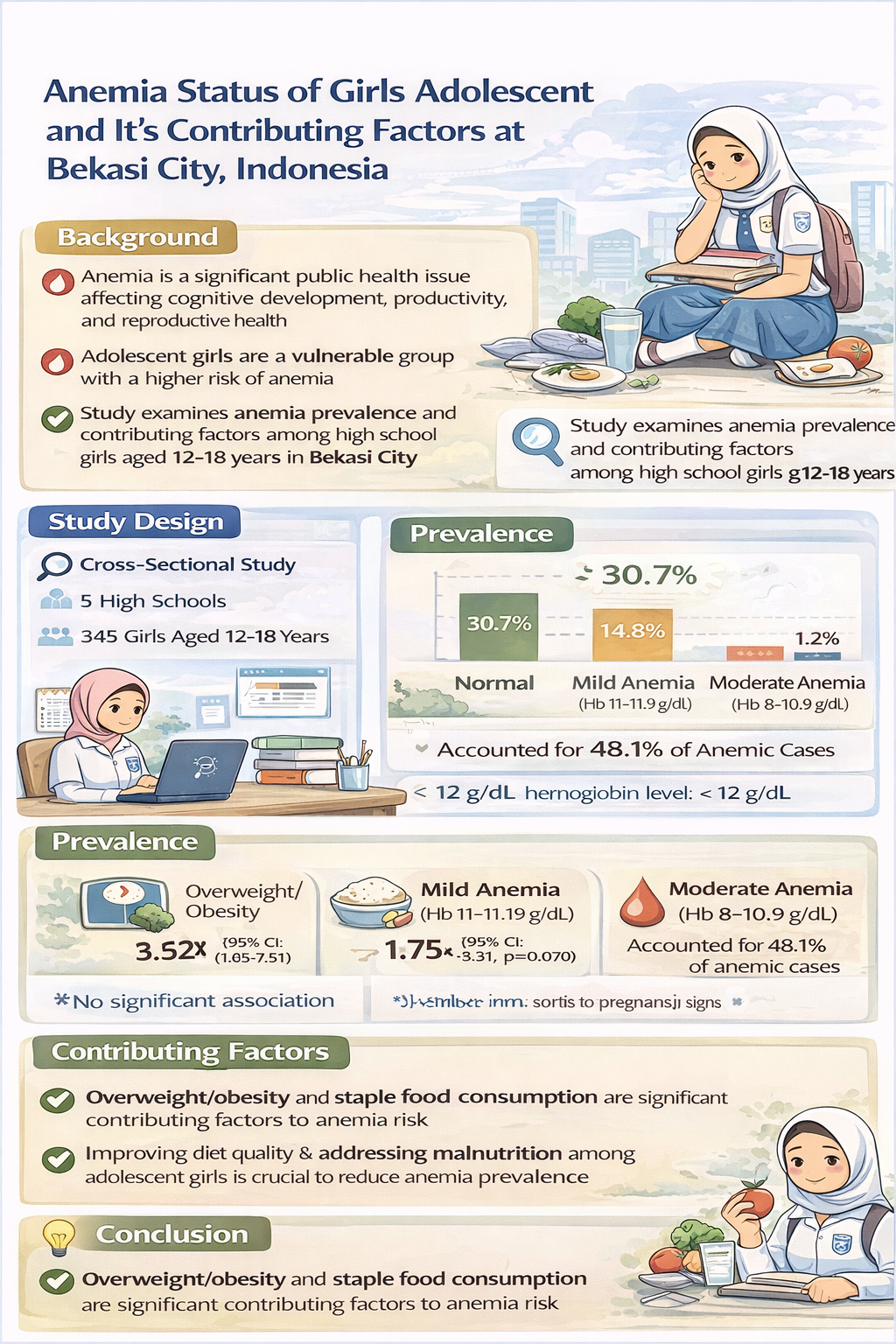
Background: Anemia remains a significant public health issue, particularly among adolescent girls, due to its impact on cognitive development, productivity, and reproductive health. This study aims to investigate the association between anemia status and specific contributing factors—including nutritional status (underweight, overweight/obese), dietary intake (staple food and protein consumption), and socioeconomic status (parental education, pocket money)—among adolescent girls aged 12–18 years in Bekasi, Indonesia.
Methods: A cross-sectional study was conducted in 2018 across five high schools in Bekasi, involving 345 adolescent girls aged 12-18 years. Data were collected through food frequency questionnaires, anthropometric measurements, and hemoglobin level tests. Anemia was classified based on WHO guidelines. Statistical analysis included univariate, bivariate, and multivariate tests to identify significant predictors.
Results: The prevalence of anemia among participants was 30.7% (95% CI: 25.9%–35.8%), with mild anemia being the most common type, accounting for 48.1% of anemic cases. Overweight or obese participants were significantly more likely to be anemic (OR = 3.52, 95% CI: 1.65–7.51, p = 0.001). Staple food consumption frequency also showed a significant association with anemia risk (OR = 1.75, 95% CI: 0.95–3.21, p = 0.070). However, no significant association was found between socioeconomic status and anemia.
Conclusion: In conclusion, this study highlights the role of nutritional status and dietary patterns in anemia prevalence among adolescent girls. Public health interventions should focus on improving dietary quality and addressing both undernutrition and overnutrition. Future research should investigate the effectiveness of iron supplementation programs, the bioavailability of iron in staple diets, and the role of fortified school meals in reducing anemia risk in this population.
Downloads
References
Aksu, T., & Ünal, Ş. (2023). Iron deficiency anemia in infancy, childhood, and adolescence. Turkish Archives of Pediatrics, 58(4), 358. https://pmc.ncbi.nlm.nih.gov/articles/PMC10440944/
Chaparro, C. M., & Suchdev, P. S. (2019). Anemia epidemiology, pathophysiology, and etiology in low‐and middle‐income countries. Annals of the New York Academy of Sciences, 1450(1), 15–31. https://nyaspubs.onlinelibrary.wiley.com/doi/full/10.1111/nyas.14092
Cheung, Y. L., Zheng, B., Rehman, Y., Zheng, Z. Y. J., & Rangan, A. (2024). Iron Content of Wheat and Rice in Australia: A Scoping Review. Foods, 13(4), 547. https://www.mdpi.com/2304-8158/13/4/547
Cohen, C. T., & Powers, J. M. (2024). Nutritional strategies for managing iron deficiency in adolescents: Approaches to a challenging but common problem. Advances in Nutrition, 100215. https://www.sciencedirect.com/science/article/pii/S2161831324000498
Dewi, N. U., & Mahmudiono, T. (2021). Effectiveness of food fortification in improving nutritional status of mothers and children in Indonesia. International Journal of Environmental Research and Public Health, 18(4), 2133. https://www.mdpi.com/1660-4601/18/4/2133
Dixit, S. P., Rajan, L., Palaniswamy, D., & Mohankumar, S. K. (2021). Importance of iron absorption in human health: An overview. Current Nutrition & Food Science, 17(3), 293–301. https://www.ingentaconnect.com/content/ben/cnf/2021/00000017/00000003/art00008
Fairweather-Tait, S. (2023). The role of meat in iron nutrition of vulnerable groups of the UK population. Frontiers in Animal Science, 4, 1142252.
Gernand, A. D., Xu, X., & West Jr, K. P. (2022). Vitamin A in Nutritional Anemia. In Nutritional Anemia (pp. 153–171). Springer. http://www.ernaehrungsdenkwerkstatt.de/fileadmin/user_upload/EDWText/TextElemente/Ernaehrungswissenschaft/Naehrstoffe/nutritional_anemia_book.pdf#page=146
Gosdin, L., Sharma, A. J., Tripp, K., Amoaful, E. F., Mahama, A. B., Selenje, L., Jefferds, M. E., Martorell, R., Ramakrishnan, U., & Addo, O. Y. (2021). A school-based weekly iron and folic acid supplementation program effectively reduces anemia in a prospective cohort of Ghanaian adolescent girls. The Journal of Nutrition, 151(6), 1646–1655. https://www.sciencedirect.com/science/article/pii/S0022316622002139
Gupta, A., Lal, P. R., Sharma, L. K., & Prakash, S. (2021). Understanding the Determinants of Anemia amongst Indian Adolescents. Int J Health Sci Res, 11(4), 213–235. Retreived from https://www.ijhsr.org/IJHSR_Vol.11_Issue.4_April2021/IJHSR028.pdf
Jeng, S.-S., & Chen, Y.-H. (2022). Association of zinc with anemia. Nutrients, 14(22), 4918. https://www.mdpi.com/2072-6643/14/22/4918
Jeong, J., Cho, Y., Cho, I.-Y., & Ahn, J. (2022). Association between obesity and anemia in a nationally representative sample of South Korean adolescents: A cross-sectional study. 10(6), 1055. https://www.mdpi.com/2227-9032/10/6/1055
Kemenkes, R. (2018). Laporan hasil riset kesehatan dasar (riskesdas) Indonesia tahun 2018. Riset Kesehatan Dasar, 2018, 182–183. Retreived from https://repository.badankebijakan.kemkes.go.id/id/eprint/3514/
Knijff, M., Roshita, A., Suryantan, J., Izwardy, D., & Rah, J. H. (2021a). Frequent consumption of Micronutrient-Rich foods is associated with reduced risk of anemia among adolescent girls and boys in Indonesia: A Cross-Sectional study. Food and Nutrition Bulletin, 42(1_suppl), S59–S71. https://journals.sagepub.com/doi/full/10.1177/0379572120977455
Kumar, S. B., Arnipalli, S. R., Mehta, P., Carrau, S., & Ziouzenkova, O. (2022). Iron deficiency anemia: Efficacy and limitations of nutritional and comprehensive mitigation strategies. Nutrients, 14(14), 2976. https://www.mdpi.com/2072-6643/14/14/2976
Kundu, S., Alam, S. S., Mia, M. A.-T., Hossan, T., Hider, P., Khalil, M. I., Musa, K. I., & Islam, M. A. (2023). Prevalence of anemia among children and adolescents of Bangladesh: A systematic review and meta-analysis. International Journal of Environmental Research and Public Health, 20(3), 1786. https://www.mdpi.com/1660-4601/20/3/1786
Kurniawan, K., & Pibriyanti, K. (2023). Increasing Knowledge of Fruit and Vegetable Consumption to Prevent Anemia in TPA Children and Adolescents. Jurnal Abdimas Kesehatan (JAKes), 1(1). https://jurnal.iaisragen.org/index.php/jakes/article/view/27
Loechl, C. U., Datta-Mitra, A., Fenlason, L., Green, R., Hackl, L., Itzkowitz, L., Koso-Thomas, M., Moorthy, D., Owino, V. O., & Pachón, H. (2023). Approaches to address the anemia challenge. The Journal of Nutrition, 153, S42–S59. https://www.sciencedirect.com/science/article/pii/S0022316623725418
Maryusman, T., Mawapi, Y. P., & Syah, M. N. H. (2020). Apakah citra tubuh dan risiko gangguan makan berisiko anemia? Studi kasus pada siswa putri. Ghidza: Jurnal Gizi Dan Kesehatan, 4(1), 22–31. https://jurnal.fkm.untad.ac.id/index.php/ghidza/article/view/34
Mithra, P., Khatib, M. N., Sinha, A. P., Kumar, N., Holla, R., Unnikrishnan, B., Vijayamma, R., Nair, N. S., Gaidhane, A., & Quazi Zahiruddin, S. (2021). Interventions for addressing anemia among children and adolescents: An overview of systematic reviews. Frontiers in Pediatrics, 8, 549549. https://www.frontiersin.org/journals/pediatrics/articles/10.3389/fped.2020.549549/full
Nair, M. K., Augustine, L. F., & Konapur, A. (2016). Food-based interventions to modify diet quality and diversity to address multiple micronutrient deficiency. Frontiers in Public Health, 3, 277. https://www.frontiersin.org/journals/public-health/articles/10.3389/fpubh.2015.00277/full
Nemeth, E., & Ganz, T. (2023). Hepcidin and iron in health and disease. Annual Review of Medicine, 74(1), 261–277. https://www.annualreviews.org/content/journals/10.1146/annurev-med-043021-032816
Ortenzi, F., & Beal, T. (2021). Priority micronutrient density of foods for complementary feeding of young children (6–23 months) in South and Southeast Asia. Frontiers in Nutrition, 8, 785227. https://www.frontiersin.org/journals/nutrition/articles/10.3389/fnut.2021.785227/full?trk=public_post_comment-text
Piskin, E., Cianciosi, D., Gulec, S., Tomas, M., & Capanoglu, E. (2022). Iron absorption: Factors, limitations, and improvement methods. ACS Omega, 7(24), 20441–20456. https://pubs.acs.org/doi/full/10.1021/acsomega.2c01833
Rahman, M. J., Rahman, M. M., Sarker, M. H. R., Kakehashi, M., Tsunematsu, M., Ali, M., Ahmed, A., Hawlader, M. D. H., & Shimpuku, Y. (2024). Prevalence and influencing factors with knowledge, attitude, and practice toward anemia among school-going adolescent girls in rural Bangladesh. PloS One, 19(11), e0313071. https://journals.plos.org/plosone/article?id=10.1371/journal.pone.0313071
Reddy, M. B., Agbemafle, I., & Armah, S. (2022). Iron bioavailability: Enhancers and inhibitors. In Nutritional anemia (pp. 141–149). Springer. https://link.springer.com/chapter/10.1007/978-3-031-14521-6_11
Restiana, G., Manggabarani, S., & Tanuwijaya, R. R. (2022). Correlaction of Protein Intake, Consumption of Fruit and Vegetables, Sodium Intake in Packaged Food with the Incidence of Anemia. Journal of Nutrition Science, 3(2), 45–50. http://jurnal.utu.ac.id/JNS/article/view/6615
Saad, R. A., & Qutob, H. M. (2022). The relationship between anemia and obesity. Expert Review of Hematology, 15(10), 911–926. https://www.tandfonline.com/doi/abs/10.1080/17474086.2022.2131521
Srivastava, S., Kumar, P., Paul, R., & Debnath, P. (2022). Effect of change in individual and household level characteristics on anemia prevalence among adolescent boys and girls in India. BMC Public Health, 22(1), 1478. https://link.springer.com/article/10.1186/s12889-022-13863-w
Stevens, G. A., Paciorek, C. J., Flores-Urrutia, M. C., Borghi, E., Namaste, S., Wirth, J. P., Suchdev, P. S., Ezzati, M., Rohner, F., & Flaxman, S. R. (2022). National, regional, and global estimates of anaemia by severity in women and children for 2000–19: A pooled analysis of population-representative data. The Lancet Global Health, 10(5), e627–e639. https://www.thelancet.com/journals/langlo/article/PIIS2214-109X(22)00084-5/fulltext
Sunuwar, D. R., Singh, D. R., Pradhan, P. M. S., Shrestha, V., Rai, P., Shah, S. K., & Adhikari, B. (2023). Factors associated with anemia among children in South and Southeast Asia: A multilevel analysis. BMC Public Health, 23(1), 343. https://link.springer.com/article/10.1186/s12889-023-15265-y
Syah, M. N. H. (2022). The Relationship between Obesity and Anemia among Adolescent Girls. Poltekita: Jurnal Ilmu Kesehatan, 15(4), 355–359. https://ojs.polkespalupress.id/index.php/JIK/article/view/712
Tandoh, M. A., Appiah, A. O., & Edusei, A. K. (2021). Prevalence of anemia and undernutrition of adolescent females in selected schools in Ghana. Journal of Nutrition and Metabolism, 2021(1), 6684839. https://onlinelibrary.wiley.com/doi/full/10.1155/2021/6684839
Taqwin, T., Amsal, A., Batjo, S. H., Radhiah, S., Ramadhan, K., Kusumawati, D. E., Hafid, F., Hariadha, E., Ahmed, F., & Raju, K. (2023). Uncovering Determinant of Anaemia Among Adolescent Girls. Poltekita: Jurnal Ilmu Kesehatan, 17(3), 1125–1135. https://ojs.polkespalupress.id/index.php/JIK/article/view/3484
Tiruneh, F. N., & Ejigu, B. A. (2024). Magnitude and Determinates of Anemia among adolescent Girls in Africa: A Multilevel, Multicounty Analysis of 24 Countries.
Wiafe, M. A., Ayenu, J., & Eli-Cophie, D. (2023). A review of the risk factors for iron deficiency anaemia among adolescents in developing countries. Anemia, 2023(1), 6406286. https://onlinelibrary.wiley.com/doi/full/10.1155/2023/6406286
World Health Organization. (2020). Global anaemia reduction efforts among women of reproductive age: Impact, achievement of targets and the way forward for optimizing efforts. https://www.who.int/publications/b/55197
Wrottesley, S. V., Mates, E., Brennan, E., Bijalwan, V., Menezes, R., Ray, S., Ali, Z., Yarparvar, A., Sharma, D., & Lelijveld, N. (2023). Nutritional status of school-age children and adolescents in low-and middle-income countries across seven global regions: A synthesis of scoping reviews. Public Health Nutrition, 26(1), 63–95. Retreived from https://pubmed.ncbi.nlm.nih.gov/35156607/
Zhu, Z., Sudfeld, C. R., Cheng, Y., Qi, Q., Li, S., Elhoumed, M., Yang, W., Chang, S., Dibley, M. J., & Zeng, L. (2021). Anemia and associated factors among adolescent girls and boys at 10–14 years in rural western China. BMC Public Health, 21, 1–14. https://link.springer.com/article/10.1186/s12889-021-10268-z