The Influence of Education on Increasing Women's Empowerment for Early Detection of Pregnancy Complications in Sigi Regency

https://doi.org/10.33860/bpk.v53i2.4174
Keywords:
Empower women, danger signs, behavior, family support, women autonomyAbstract
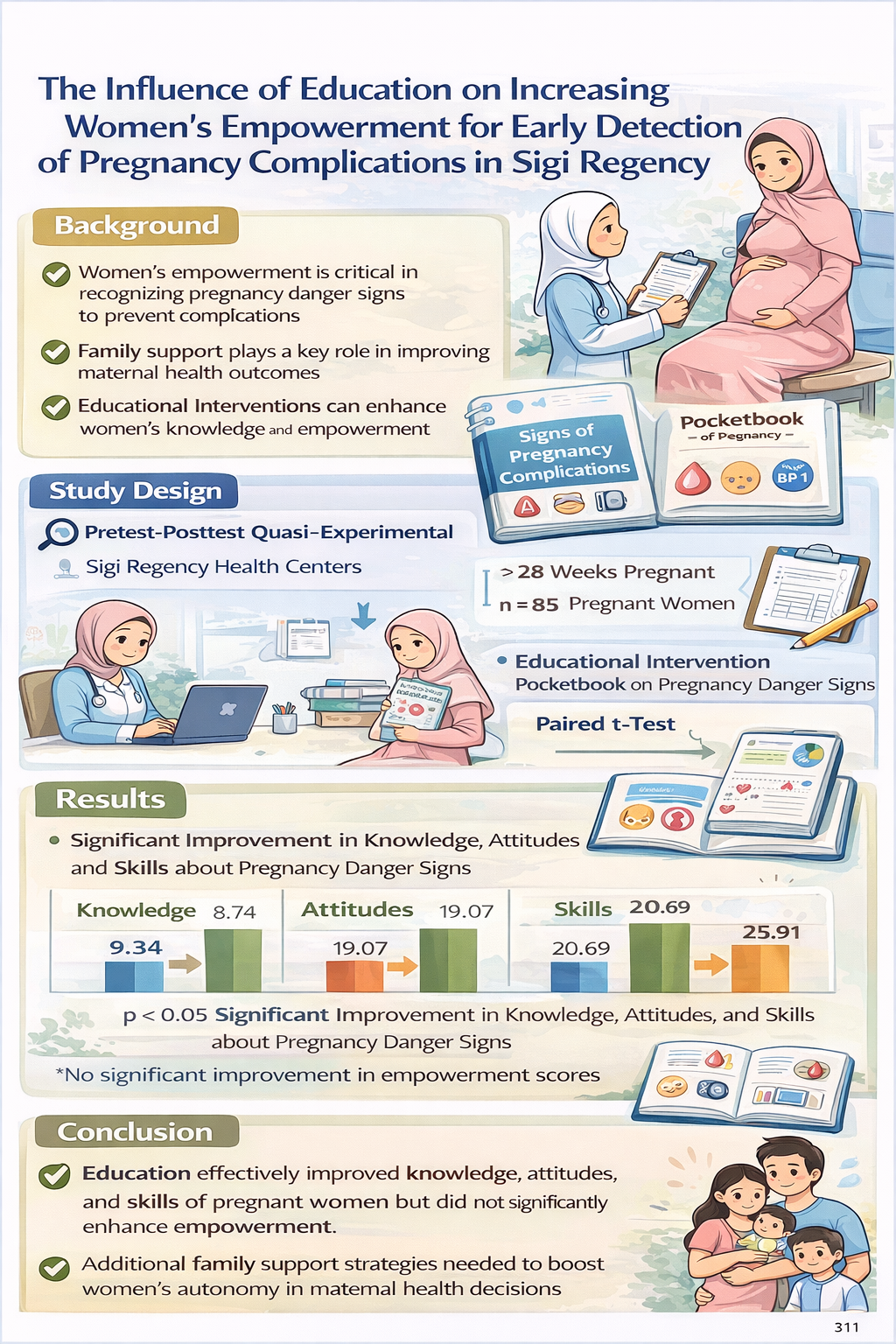
Background: Women’s empowerment plays a critical role in improving maternal and family health, particularly through timely recognition of pregnancy danger signs and informed decision-making. Educational interventions are expected to enhance women’s knowledge, attitudes, skills, and empowerment related to the early detection of pregnancy complications. This study examined the effect of education on women’s empowerment and behavioral outcomes regarding pregnancy danger signs among third-trimester pregnant women in Sigi Regency, Indonesia.
Methods: A quantitative quasi-experimental study with a pretest–posttest design without a control group was conducted from June to October 2023. Eighty-five pregnant women with gestational age >28 weeks were recruited from four community health centers. Participants received structured education using a pocket book on danger signs during pregnancy, childbirth, and the postpartum period. Data were collected using a validated self-reported questionnaire. Paired t-tests were used for data analysis.
Results: Mean scores for knowledge (8.74 to 9.35), attitudes (19.07 to 21.46), and skills (20.69 to 25.91) regarding pregnancy danger signs increased significantly after the intervention (p<0.05). Although the empowerment score increased (14.65 to 16.27), the difference was not statistically significant (p>0.05).
Conclusion: Educational intervention effectively improved pregnant women’s knowledge, attitudes, and skills related to pregnancy danger signs, but was insufficient to significantly enhance women’s empowerment. Comprehensive, family-centered strategies are needed to strengthen women’s autonomy in maternal health decision-making.
Downloads
References
Abdulai, M. G., Salifu, M., & Domanban, P. B. (2024). Determinants of multi-dimensional women empowerment in Mali. Cogent Economics and Finance, 12(1). https://doi.org/10.1080/23322039.2024.2383098
Abebe, Y., Demissie, A., & Adugna, K. (2025). The association of women’s empowerment dimensions and antenatal care utilization in Ethiopia; facility based cross-sectional study. BMC Women’s Health, 25(1). https://doi.org/10.1186/s12905-025-03743-x
Abreha, S. K., & Zereyesus, Y. A. (2021). Women’s Empowerment and Infant and Child Health Status in Sub-Saharan Africa: A Systematic Review. Maternal and Child Health Journal, 25(1), 95–106. https://doi.org/10.1007/s10995-020-03025-y
Agazhi, Z. D. (2023). Determinants of Women Empowerment in Bishoftu Town; Oromia Regional State of Ethiopia. International Journal of Rural Development, Environment and Health Research, 7(6), 01–08. https://doi.org/10.22161/ijreh.7.6.1
Ang, C. W., & Lai, S. L. (2023). Women’s Empowerment and Modern Contraceptive Use: Evidence from Four Southeast Asian Countries. Journal of International Women’s Studies, 25(4). https://vc.bridgew.edu/jiws/vol25/iss4/11/
Chol, C., Negin, J., Agho, K. E., & Cumming, R. G. (2019). Women’s autonomy and utilisation of maternal healthcare services in 31 Sub-Saharan African countries: Results from the demographic and health surveys, 2010-2016. BMJ Open, 9(3), 1–9. https://doi.org/10.1136/bmjopen-2018-023128
Dangura, A. D. (2020). Knowledge about child birth and postpartum obstetric danger signs and associated factors among mothers in Dale district, Southern Ethiopia. BMC Pregnancy and Childbirth, 20(1), 1–12. https://doi.org/10.1186/s12884-020-02989-7
Dinas Kesehatan Provinsi Sulawesi Tengah. (2021). Profil Kesehatan Provinsi Sulawesi Tengah. Profil Kesehat Provinsi Sulawesi Tengah. https://dinkes.sultengprov.go.id/wp-content/uploads/2023/06/Profil-KEsehatan-2022.pdf
ha, N., & Ansari, M. A. (2020). Proximate Determinants of Women Empowerment: A Review. International Journal of Current Microbiology and Applied Sciences, 9(10), 3271–3284. https://doi.org/10.20546/ijcmas.2020.910.391
Herinawati, H., Diniyati, D., Danaz, A. F., & Iksaruddin, I. (2021). Pemberdayaan Masyarakat dalam Mengenali Tanda-Tanda Bahaya pada Masa Kehamilan di Desa Penyengat Olak Kabupaten Muaro Jambi Tahun 2020. Jurnal Abdimas Kesehatan (JAK), 3(1), 93. https://doi.org/10.36565/jak.v3i1.184
Hermawati, D. (2019). Empowerment Of Pregnancy Care For Pregnant Women: A Concept Analysis. Idea Nursing Journal, 2. https://scispace.com/pdf/empowerment-of-pregnancy-care-for-pregnant-women-a-concept-knxzd6wpsi.pdf
IFAD, & ILO. (2017). Promoting women’s empowerment in the Middle East and North Africa: A rapid evidence assessment of labour market interventions Investing in rural people. 9, 1–12. https://www.ilo.org/sites/default/files/wcmsp5/groups/public/@ed_emp/documents/publication/wcms_563865.pdf
Juniarti, S., Mularsih, S., (2024). Benefits of Women's Empowerment in Midwifery Services: Scooping Review. Indonesian Journal of Global Health Research, 6(4), 2229–2238. https://jurnal.globalhealthsciencegroup.com/index.php/IJGHR/article/view/3396
Kebede, Z. T., Toni, A. T., Amare, A. T., Ayele, T. A., Yilma, T. M., Delele, T. G., Biks, G. A., & Gelaye, K. A. (2022). Mothers experience on neonatal danger signs and associated factors in northwest Ethiopia: a community based cross-sectional study. Pan African Medical Journal, 41. https://doi.org/10.11604/pamj.2022.41.83.32176
Mardiyanti, I., Pratama, A. W., Rizki, L. K., & Rahayu, P. (2024). The effect of family empowerment on hemoglobin levels in pregnant women. Healthcare in Low-resource Settings. 12(3), 1–5. https://www.pagepressjournals.org/hls/article/view/11987
Nath, S., & Das, G. (2025). Does women empowerment impact child well-being? Evidence from India. Social Science & Medicine, 367. https://www.sciencedirect.com/science/article/abs/pii/S0277953625000152
Ngo, E., Truong, M. B. T., & Nordeng, H. (2020). Use of decision support tools to empower pregnant women: Systematic review. Journal of Medical Internet Research, 22(9), 1–10. https://doi.org/10.2196/19436
Nikbakht Nasrabadi, A., Sabzevari, S., & Negahban Bonabi, T. (2015). Women Empowerment through Health Information Seeking: A Qualitative Study. International Journal of Community Based Nursing and Midwifery, 3(2), 105–115. https://pubmed.ncbi.nlm.nih.gov/26005690/
Prata, N., Tavrow, P., & Upadhyay, U. (2017). Women’s empowerment related to pregnancy and childbirth: Introduction to special issue. BMC Pregnancy and Childbirth, 17. https://doi.org/10.1186/s12884-017-1490-6
Rahyani., N. K. Y. (2020). Inequality in the Management of Neonatal Maternal Emergency Cases: Factors contributing to the inequality of maternal and neonatal care in Denpasar City and Fakfak Regency, Indonesia (1st ed.). LAP LAMBERT Academic Publishing.
Rahyani, N. K., & Suardana, I. W. (2019). Inequity in Applying Midwifery Standards of Practice by Midwives on Early Detection and Management of Maternal Neonatal Emergency in Denpasar City and Fakfak District , Papua Indonesia. International Journal of Science and Research (IJSR), 8(12), 895–898. https://doi.org/10.21275/ART20203301
Sey-Sawo, J., Sarr, F., Bah, H. T., & Senghore, T. (2023). Women’s empowerment and nutritional status of children in the Gambia: further analysis of the 2020 Gambia demographic and health survey. BMC Public Health, 23(1), 1–13. https://doi.org/10.1186/s12889-023-15494-1
Tavananezhad, N., Bolbanabad, A. M., Ghelichkhani, F., Effati-Daryani, F., & Mirghafourvand, M. (2022). The relationship between health literacy and empowerment in pregnant women: a cross-sectional study. BMC Pregnancy and Childbirth, 22(1). https://doi.org/10.1186/s12884-022-04686-z
WHO, UNAIDS, UNFPA, UNICEF, UN WOMEN, T. W. B. (2018). Survive, Thrive ,Transform current status and strategic priorities. Global Strategy for Women’s, Children’s and Adolescents’ Health (2016–2030), 15(November), 68. https://www.unaids.org/sites/default/files/media_asset/EWECGSMonitoringReport2018_en.pdf
Winters, S., Pitchik, H. O., Akter, F., Yeasmin, F., Jahir, T., Huda, T. M. N., Rahman, M., Winch, P. J., Luby, S. P., & Fernald, L. C. H. (2023). How does women’s empowerment relate to antenatal care attendance? A cross-sectional analysis among rural women in Bangladesh. BMC Pregnancy and Childbirth, 23(1), 1–12. https://doi.org/10.1186/s12884-023-05737-9
World Health Organization. (2018). Quality, equity, dignity: the network to improve quality of care for maternal, newborn and child health. https://www.who.int/publications/i/item/9789241513951
Wulandari, R. D., & Laksono, A. D. (2020). Determinants of knowledge of pregnancy danger signs in Indonesia. PLoS ONE, 15(5), 1–11. https://doi.org/10.1371/journal.pone.0232550
Yosef, T., & Tesfaye, M. (2021). Pregnancy danger signs: Knowledge and health-seeking behavior among reproductive age women in southwest Ethiopia. Women’s Health, 17. https://doi.org/10.1177/17455065211063295