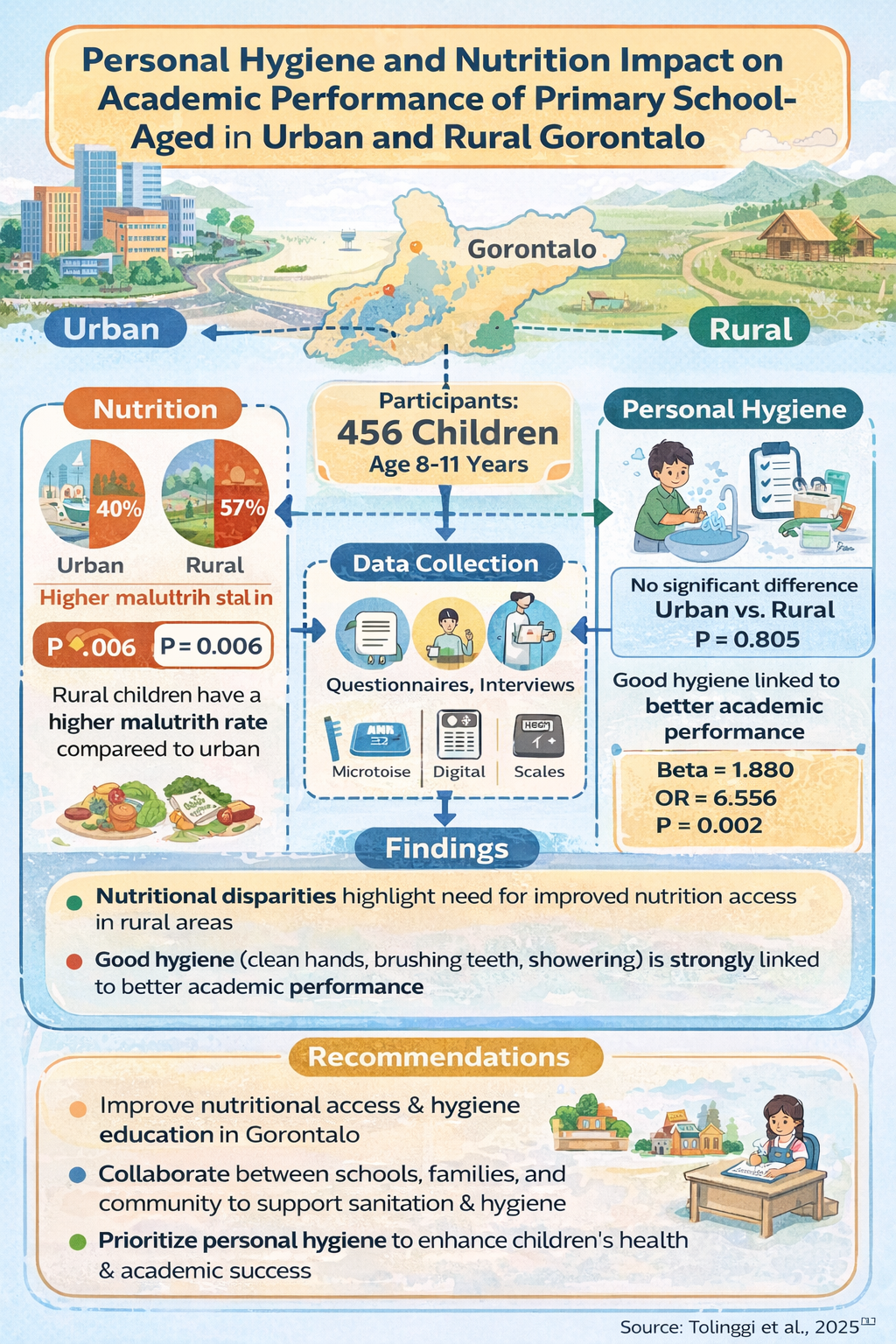
Personal Hygiene and Nutrition Impact on Academic Performance of Primary School-Aged in Urban and Rural Gorontalo

https://doi.org/10.33860/bpk.v53i2.4001
Keywords:
Personal Hygiene, Nutrition, Academic Performance, Primary School-AgedAbstract
Introduction: Cultural and socioeconomic factors affecting sanitation, hygiene, and academic performance in Gorontalo remain unexplored, necessitating further study to develop targeted interventions and foster collaboration among stakeholders. This research aims to analyze the relationship between nutrition, personal hygiene, and academic performance among primary school students in Gorontalo.
Methods: An observational cross-sectional study was conducted in Gorontalo City and Gorontalo Regency in 2019, involving 456 children aged 8–11. Data were collected through questionnaires, interviews, weight (digital scales), and height measurements (microtoise). Statistical analysis was performed using chi-square and logistic regression techniques.
Results: Results indicated no significant difference in personal hygiene between urban and rural students (p=0.805), but significant variation in nutritional status (p=0.006). Regression analysis showed a strong correlation between personal hygiene and academic performance (β=1.880, OR=6.556, p=0.002). These findings underscore personal hygiene as a critical factor for improving academic performance, particularly as outdoor play activities may compromise hygiene among primary school-aged children. Enhancing personal hygiene should therefore be prioritized to improve both health and education outcomes.
Conclusion: Although no major differences in hygiene were found, nutritional disparities highlight the need for interventions addressing access to nutrition and hygiene education. Recommendations include fostering collaboration between schools, families, and community stakeholders to address sanitation and hygiene issues comprehensively. Further research should investigate cultural and socioeconomic factors influencing the interplay between hygiene, nutrition, and academic outcomes, ensuring context-specific strategies are implemented to enhance children’s well-being and performance.
Downloads
References
Amany, T., & Sekartini, R. (2017). Hubungan antara Status Gizi dengan Prestasi Belajar Siswa SDN 03 Pondok Cina Depok Tahun 2015. Sari Pediatri, 18(6), 487. https://doi.org/10.14238/sp18.6.2017.487-91
Anuar Zaini, M. Z., Lim, C. T., Low, W. Y., & Harun, F. (2005). Effects of nutritional status on academic performance of Malaysian primary school children. Asia-Pacific Journal of Public Health, 17(2), 81–87. https://doi.org/10.1177/101053950501700204
Ashworth, A. (1969). Growth rates in children recovering from protein-calorie malnutrition. British Journal of Nutrition, 23(4), 835–845. https://doi.org/10.1079/bjn19690094
Asmare, B., Taddele, M., Berihun, S., & Wagnew, F. (2018). Nutritional status and correlation with academic performance among primary school children, northwest Ethiopia. BMC Research Notes, 11(1), 1–6. https://doi.org/10.1186/s13104-018-3909-1
Burrows, T. L., Whatnall, M. C., Patterson, A. J., & Hutchesson, M. J. (2017). Associations between dietary intake and academic achievement in college students: A systematic review. Healthcare (Switzerland), 5(4). https://doi.org/10.3390/healthcare5040060
Central Agency of Statistics. (2018). Indeks Pembangunan Manusia 2018 (A. Said, W. Winardi, & Y. Karyono, eds.). Jakarta: Central Agency of Statistics.
Damanik, D. M., Soeyoko, & Husodo, A. H. (2014). Sanitation of House and School, Personal Hygiene and Infection of Soil Transmitted Helminths among Elementary School Students. International Journal of Public Health Science (IJPHS), 3(1), 43. https://doi.org/10.11591/ijphs.v3i1.4673
Directorate General of Basic and Secondary Education. (2018). Pedoman Pengembangan Sanitasi Sekolah Dasar (pp. 5–6). pp. 5–6. Jakarta: Ministry of Education and Culture Republic of Indonesia.
Fariza, A. (2013). Hubungan Status Gizi dengan Tingkat Sosial Ekonomi Orang Tua / Wali Murid Siswa Kelas Atas Sekolah Dasar Negeri 3 Jatiluhur Kecamatan Karanganyar Kabupaten Kebumen. Universitas Negeri Yogyakarta.
Freeman, M. C., Garn, J. V., Sclar, G. D., Boisson, S., Medlicott, K., Alexander, K. T., … Clasen, T. F. (2017). The impact of sanitation on infectious disease and nutritional status: A systematic review and meta-analysis. International Journal of Hygiene and Environmental Health, 220(6), 928–949. https://doi.org/10.1016/j.ijheh.2017.05.007
Gabur, M. G. J., Yudiernawati, A., & Dewi, N. (2017). Hubungan Perilaku Hidup Bersih dan Sehat (PHBS) Terhadap Personal Hygiene Anak Usia Sekolah Di SDN Tlogamas 2 Malang. Nursing News Jurnal Ilmiah Keperawatan, 2(1), 533–42.
Gebrehiwot, T., Geberemariyam, B. S., Gebretsadik, T., & Gebresilassie, A. (2020). Prevalence of diarrheal diseases among schools with and without water, sanitation and hygiene programs in rural communities of north-eastern Ethiopia: a comparative cross-sectional study. Rural and Remote Health, 20(4), 4907. https://doi.org/10.22605/RRH4907
Ghanim, M., Dash, N., Abdullah, B., Issa, H., Albarazi, R., & Saheli, Z. Al. (2016). Knowledge and Practice of Personal Hygiene among Primary School Students in Sharjah-UAE. Journal of Health Science, 6(5), 67–73.
Gunter, K. B., Nader, P. A., & John, D. H. (2015). Physical activity levels and obesity status of Oregon Rural Elementary School children. Preventive Medicine Reports, 2, 478–482. https://doi.org/10.1016/j.pmedr.2015.04.014
Hirachand, A. D., Talakeri, P. Y., Angolkar, M., & Sah, J. K. (2015). A Comparative Assessment of Knowledge and Practice Regarding Personal Hygiene among Urban and Rural School Children in Belgavi, India. International Journal of Current Research, 7(05), 15768–15772.
Izzaty, R. E., Suardiman, S. P., Ayriza, Y., Purwandar, Hiryanto, & Kusmaryani, R. E. (2007). Perkembangan Peserta Didik (Bahan Ajar). Yogyakarta: Fakultas Ilmu Pendidikan. Universitas Negeri Yogyakarta.
Jasper, C., Le, T. T., & Bartram, J. (2012). Water and sanitation in schools: A systematic review of the health and educational outcomes. International Journal of Environmental Research and Public Health, 9(8), 2772–2787. https://doi.org/10.3390/ijerph9082772
Joshi, A., & Amadi, C. (2013). Impact of water, sanitation, and hygiene interventions on improving health outcomes among school children. Journal of Environmental and Public Health, 2013. https://doi.org/10.1155/2013/984626
Karak, P., Maiti, R., Das, P., & Karmakar, A. (2018). Assessment of Nutritional Status of School Children in Rural and Urban Areas of Bankura, West Bengal. International Journal of Pharmaceutical Sciences and Research, 9(1), 338. https://doi.org/10.13040/IJPSR.0975-8232.9(1).338-45
Karon, A. J., Cronin, A. A., Cronk, R., & Hendrawan, R. (2017). Improving water, sanitation, and hygiene in schools in Indonesia: A cross-sectional assessment on sustaining infrastructural and behavioral interventions. International Journal of Hygiene and Environmental Health, 220(3), 539–550. https://doi.org/10.1016/j.ijheh.2017.02.001
Keusch, G. T., Fontaine, O., Bhargava, A., Boschi-Pinto, C., Bhutta, Z. A., Gotuzzo, E., … Laxminarayan, R. (2006). Diarrheal diseases. In: Disease Control Priorities in Developing Countries. In Diarrheal diseases. In: Disease Control Priorities in Developing Countries. (2nd ed., pp. 371–388). New York: Oxford University Press. Retrieved from https://www.ncbi.nlm.nih.gov/books/NBK11764/
Liu, J.-H., Jones, S. J., Sun, H., Probst, J. C., Merchant, A. T., & Cavicchia, P. (2012). Diet, Physical Activity, and Sedentary Behaviors as Risk Factors for Childhood Obesity: An Urban and Rural Comparison. Childhood Obesity, 8(5), 440–448. https://doi.org/10.1089/chi.2011.0090
Mardliyah, U., Yugistyowati, A., & Aprilia, V. (2014). Pola Asuh Orang Tua Sebagai Faktor Penentu Kualitas Pemenuhan Kebutuhan Dasar Personal Hygiene Anak Usia 6-12 Tahun. Jurnal Ners Dan Kebidanan Indonesia, 2(2), 86–92.
Ministry of Education and Culture. (2017). Profil Sanitasi Sekolah 2017. Jakarta: Ministry of Education, Culture, Research, and Technology’s Center for Data and Statistics of Education and Culture and United Nation Children’s Fund (UNICEF).
Mongan, J. J. S. (2019). Pengaruh Pengeluaran Pemerintah Bidang Pendidikan dan Kesehatan Terhadap Indeks Pembangunan Manusia di Indonesia. Indonesian Treasury Review Jurnal Perbendaharaan, Keuangan Negara Dan Kebijakan Publik, 4(2), 163–176. https://doi.org/https://doi.org/10.33105/itrev.v4i2.122
Mulyadi, Rahfiludin, M. Z., & P, D. R. (2019). Hubungan Status Gizi dan Kecukupan Gizi Makan Pagi dengan Prestasi Belajar Siswa SD Negeri Sidomulyo 01 Kecamatan Wonosalam Kabupaten Demak. Jurnal Kesehatan Masyarakat (e-Journal), 1(4), 21–27.
Naotunna, N. P. G. C. R., Dayarathna, M., Maheshi, H., Amarasinghe, G. S., Kithmini, V. S., Rathnayaka, M., … Agampodi, S. B. (2017). Nutritional status among primary school children in rural Sri Lanka; A public health challenge for a country with high child health standards. BMC Public Health, 17(1), 1–11. https://doi.org/10.1186/s12889-016-4001-1
Notoatmodjo, S. (2012). Promosi Kesehatan dan Perilaku Kesehatan. Jakarta: Rineka Cipta.
O’Reilly, C. E., Freeman, M. C., Ravani, M., Migele, J., Mwaki, A., Ayalo, M., … Quick, R. (2008). The impact of a school-based safe water and hygiene programme on knowledge and practices of students and their parents: Nyanza Province, western Kenya, 2006. Epidemiology and Infection, 136(1), 80–91. https://doi.org/10.1017/S0950268807008060
Pingge, H. D., & Wangid, M. N. (2016). Faktor yang Mempengaruhi Hasil Belajar Siswa Sekolah Dasar di Kecamatan Kota Tambolaka. Jurnal Pendidikan Sekolah Dasar, 2(1), 147–167.
Puspitasari, R. (2014). Pengaruh Status Gizi Anak Usia 6 Sampai 7 Tahun Terhadap Erupsi Gigi. Universitas Muhammadiyah Surakarta.
Rizki, N., Awaluddin, & Tursinawati. (2017). Hubungan Status Gizi dengan Hasil Belajar Siswa Kelas 1 SD Negeri 5 Banda Aceh. Jurnal Ilmiah Pendidikan Guru Sekolah Dasar FKIP Unsyiah, 2(April), 45–51.
Rosenberg, I. H., Solomons, N. W., & Schneider, R. E. (1977). Malabsorption associated with diarrhea and intestinal infections. The American Journal of Clinical Nutrition, 30(8), 1248–1253. https://doi.org/https://doi.org/10.1093/ajcn/30.8.1248
Sa’adah, R. H., Herman, R. B., & Sastri, S. (2014). Hubungan Status Gizi dengan Prestasi Belajar Siswa Sekolah Dasar Negeri 01 Guguk Malintang Kota Padangpanjang. Jurnal Kesehatan Andalas, 3(3), 460–465. https://doi.org/10.25077/jka.v3i3.176
Saputri, Y. V. S., Setyawan, H., Wuryanto, M. A., & Udiyono, A. (2019). Analisis Hubungan antara Sedentary Lifestyle dengan Kejadian Obesitas pada Usia Sekolah Dasar Kelas 4-6 (Studi di Kota Salatiga). Jurnal Kesehatan Masyarakat, 7(1), 236–245. Retrieved from http://ejournal3.undip.ac.id/index.php/jkm
Sari, Y. I., & Hidayat, F. R. (2018). Gambaran Perilaku Siswa Tentang Cuci Tangan Pakai Sabun (CTPS) Kelas 5-6 Di Sekolah Dasar Negeri 020 Samarinda Utara. Samarinda.
Shariff, Z. M., Bond, J. T., & Johnson, N. E. (2000). Nutrition and educational achievement of urban primary schoolchildren in Malaysia. Asia Pacific Journal of Clinical Nutrition, 9(4), 264–273. https://doi.org/10.1046/j.1440-6047.2000.00191.x
Soekatri, M., Sandjaja, N., & Widodo, Y. (2013). Pencapaian Pertumbuhan Anak Indonesia Umur 0,5–12,9 Tahun. Gizi Indonesia, 36(2), 109. https://doi.org/10.36457/gizindo.v36i2.139
Soetjiningsih, & Gde Ranuh, I. N. (2016). Tumbuh kembang anak (2nd ed.; Soetjiningsih & I. N. G. Ranuh, Eds.). Jakarta: EGC.
Supariasa, D. N., Bakri, B., & Fajar, I. (2016). Penilaian Status Gizi (Edisi 2). Jakarta: EGC.
Temitayo, I. O. (2016). Knowledge and Practices of Personal Hygiene among Senior Secondary School Students of Ambassadors College, Ile- Ife, Nigeria. Texila International Journal of Public Health, 4(4), 648–660. https://doi.org/10.21522/tijph.2013.04.04.art055
Triasmari, U., & Kusuma, A. N. (2019). Determinan Personal Hygiene Pada Anak Usia 9–12 Tahun. Faletehan Health Journal, 6(1), 37–44. https://doi.org/10.33746/fhj.v6i1.47
Trinies, V., Garn, J. V., Chang, H. H., & Freeman, M. C. (2016). The impact of a school-based water, sanitation, and hygiene program on absenteeism, diarrhea, and respiratory infection: A matched-control trial in Mali. American Journal of Tropical Medicine and Hygiene, 94(6), 1418–1425. https://doi.org/10.4269/ajtmh.15-0757
UNICEF. (2012, July). Water, Sanitation and Hygiene (WASH) in Schools. A companion to the Child Friendly Schools Manual. Unicef, 1–51.
Utari, L. D., Ernalia, Y., & Suyanto. (2016). Gambaran status gizi dan asupan zat gizi pada siswa sekolah dasar Kecamatan Sungai Sembilan Kota Dumai. JOM FK, 3(1), 1–17.
Yeasmin, S., & Islam, K. (2016). A comparative study of health, nutritional status, and dietary pattern of primary school going and dropout slum children in Dhaka City, Bangladesh. Asian Journal of Medical Sciences, 7(4), 59–63. https://doi.org/10.3126/ajms.v7i4.14558
Zaini, M. Z. A., Lim, C. T., Low, W. Y., & Harun, F. (2005). Effects of Nutritional Status on Academic Performance of Malaysian Primary School Children. Asia Pacific Journal of Public Health, 17(2), 81–87. Retrieved from http://www.jstor.org/stable/26723362