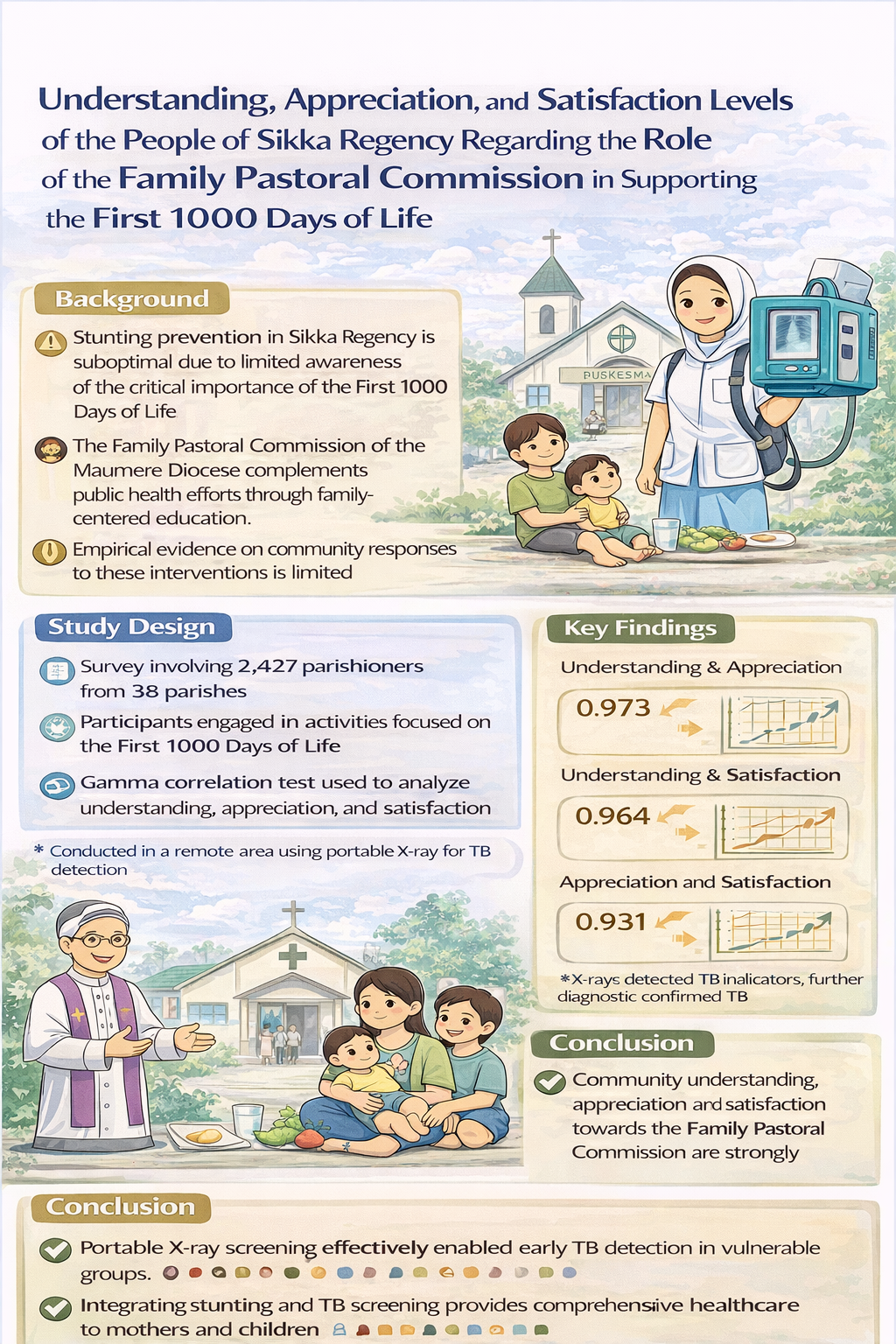
The Analysis of Understanding, Appreciation, and Satisfaction Levels of the People of Sikka Regency Regarding the Role of the Family Pastoral Commission in Supporting the First 1000 Days of Life

https://doi.org/10.33860/bpk.v53i2.3957
Keywords:
Family Commission, Pastoral, Diocese, Support, First 1,000 Days of LifeAbstract
Background: Stunting prevention in Sikka Regency remains suboptimal, partly due to limited community awareness of the critical importance of the First 1,000 Days of Life. Faith-based organizations, such as the Family Pastoral Commission of the Maumere Diocese, have the potential to complement public health efforts through family-centered education; however, empirical evidence on community responses to these interventions is limited. This study aimed to examine the relationship between community understanding, appreciation, and satisfaction regarding the Commission’s role in supporting the First 1,000 Days of Life.
Methods: A quantitative cross-sectional correlational study was conducted among 2,427 respondents from 38 parishes who had participated in First 1,000 Days of Life–related activities. Data were collected between June and September 2024 using validated questionnaires and analyzed using the Gamma correlation test.
Results: Strong and statistically significant positive correlations were observed between understanding and appreciation (r = 0.973), understanding and satisfaction (r = 0.964), and appreciation and satisfaction (r = 0.931) (p < 0.05).
Conclusion: Community understanding strongly influences appreciation and satisfaction toward faith-based interventions in stunting prevention. Strengthening educational content and facilitator capacity within family pastoral programs may enhance multisectoral efforts to reduce stunting.
Downloads
References
Briend, A., Khara, T., & Dolan, C. (2015). Wasting and stunting–similarities and differences: Policy and programmatic implications. Food and Nutrition Bulletin, 36(March), S15–S23. https://doi.org/10.1177/15648265150361S103
Christian, P., Lee, S. E., Angel, M. D., Adair, L. S., Arifeen, S. E., Ashorn, P., Barros, F. C., Fall, C. H. D., Fawzi, W. W., Hao, W., Hu, G., Humphrey, J. H., Huybregts, L., Joglekar, C. V., Kariuki, S. K., Kolsteren, P., Krishnaveni, G. V., Liu, E., Martorell, R., ... Black, R. E. (2013). Risk of childhood undernutrition related to small-for-gestational age and preterm birth in low- and middle-income countries. International Journal of Epidemiology, 42(5), 1340–1355. https://doi.org/10.1093/ije/dyt109
Darsini, F., & Cahyono, E. A. (2019). Pengetahuan; artikel review. Jurnal Keperawatan, 12(1), 97. Retrieved from https://e-journal.lppmdianhusada.ac.id/index.php/jk/article/view/96
Fentiana, N., Nasution, D. A., & Ginting, D. (2021). Pengetahuan 1000 HPK ibu dan stunting balita di desa non prioritas stunting. Jurnal Ilmiah Universitas Batanghari Jambi, 21(3), 1184. https://doi.org/10.33087/jiubj.v21i3.1631
Hidayati, D. U., Yulastini, F., & Fajriani, E. (2022). Pengaruh edukasi 1000 hari pertama kehidupan (HPK) terhadap pengetahuan dan sikap wanita usia subur (WUS). Holistic Nursing and Health Science, 5(2), 169–177. https://doi.org/10.14710/hnhs.5.2.2022.25-3
Hijrawati, A. N. U., Syarif, S., Hadju, V., As’ad, S., & Baso, Y. S. (2021). Use of technology for monitoring the development of nutritional status 1000 HPK in stunting prevention in Indonesia. Gaceta Sanitaria, 35, S231–S234. https://doi.org/10.1016/j.gaceta.2021.10.028
Jonathan Saswono. (2006). Metode penelitian kualitatif dan kuantitatif. Retrieved from https://id.z-library.sk/book/25497601/ed3793/metodologi-penelitian-kuantitatif-kualitatif.html
Julaecha, J. (2020). Edukasi periode emas 1000 hari pertama kehidupan. Jurnal Abdimas Kesehatan (JAK), 2(3), 163. https://doi.org/10.36565/jak.v2i3.109
Kristjansson, E., Francis, D. K., Liberato, S., Benkhalti Jandu, M., Welch, V., Batal, M., Greenhalgh, T., Noonan, E., Shea, B., Janzen, L., Wells, G. A., Petticrew, M., & Rader, T. (2015). Months to five years (review). https://doi.org/10.1002/14651858.CD009924.pub2
Lui, J. C., Nilsson, O., & Baron, J. (2014). Recent insights into the regulation of the growth plate. Journal of Molecular Endocrinology, 53(1), 1–16. https://doi.org/10.1530/JME-14-0022
De Onis, M., & Branca, F. (2016). Childhood stunting: A global perspective. Maternal and Child Nutrition, 12, 12–26. https://doi.org/10.1111/mcn.12231
Petri, W. A., Naylor, C., & Haque, R. (2014). Environmental enteropathy and malnutrition: Do we know enough to intervene? BMC Medicine, 12(1), 1–5. https://doi.org/10.1186/s12916-014-0187-1
Rezaeizadeh, G., Mansournia, M. A., Keshtkar, A., Farahani, Z., Zarepour, F., Sharafkhah, M., Kelishadi, R., & Poustchi, H. (2024). Maternal education and its influence on child growth and nutritional status during the first two years of life: A systematic review and meta-analysis. EClinicalMedicine, 71. https://doi.org/10.1016/j.eclinm.2024.102574
Septiawati, I. (2018). Hubungan pengetahuan ibu tentang gerakan 1000 hari pertama kehidupan dengan kejadian stunting pada balita di wilayah kerja Puskesmas Boom Baru Palembang. Jurnal, 3(2), 91–102. Retrieved from https://repository.unsri.ac.id/12539/
Sheehy, T., Carey, E., Sharma, S., & Biadgilign, S. (2019). Trends in energy and nutrient supply in Ethiopia: A perspective from FAO food balance sheets. Nutrition Journal, 18(1), 1–12. https://doi.org/10.1186/s12937-019-0471-1
Shekar, M., Kakietek, J., D’Alimonte, M. R., Rogers, H. E., Eberwein, J. D., Akuoku, J. K., Pereira, A., Soe-Lin, S., & Hecht, R. (2017). Reaching the global target to reduce stunting: An investment framework. Health Policy and Planning, 32(5), 657–668. https://doi.org/10.1093/heapol/czw184
Smith, L. C., & Had Dad, L. (2020). Explaining child malnutrition in developing countries. Retrieved from https://ageconsearch.umn.edu/record/16532?v=pdf
Suryagustina, W. A., & Jumielsa. (2018). Pengaruh pendidikan kesehatan tentang pencegahan stunting terhadap pengetahuan dan sikap ibu di Kelurahan Pahandut Palangka Raya. Jurnal Dinamika Kesehatan Masyarakat, 9(2). Retrieved from https://ojs.dinamikakesehatan.unism.ac.id/index.php/dksm/article/view/373
Torlesse, H., Cronin, A. A., Sebayang, S. K., & Nandy, R. (2016). Determinants of stunting in Indonesian children: Evidence from a cross-sectional survey indicate a prominent role for the water, sanitation and hygiene sector in stunting reduction. BMC Public Health, 16(1), 1–11. https://doi.org/10.1186/s12889-016-3339-8
Vrolijk, K., Wauchope, S., Alnaqshbandi, I., Perellon, C., Reboul-, A., Young, U., Declerck, F., Demaio, A., Harris, J., Hollis, J., Mccoll, K., Munn-chernoff, M., Nisbett, N., Onah, M. N., Tatlow-golden, M., & Walters, D. (2019). Children, food and nutrition. Retrieved from https://www.studypool.com/documents/24028579/children-food-and-nutrition-by-unicef
Wardani, N. E. K., Harumi, A. M., & Sholikah, S. M. (2023). Analysis of the 1000 HPK program (first day of life) towards effort to reduce stunting at the Bangkalan District Health Center. Malahayati Nursing Journal, 5(4), 969–986. https://doi.org/10.33024/mnj.v5i4.8242.
Winterfeld, A. (2010). Improving child nutrition (Vol. 18). Retrieved from https://pubmed.ncbi.nlm.nih.gov/20196250/
Wong, H. J., Moy, F. M., & Nair, S. (2014). Risk factors of malnutrition among preschool children in Terengganu, Malaysia: A case control study. BMC Public Health, 14(1), 1–10. https://doi.org/10.1186/1471-2458-14-785
World Health Organisation. (2019). Nutrition in universal health coverage (WHO/NMH/NHD/19.24). https://www.who.int/publications/i/item/WHO-NMH-NHD-19.24
Wright, C. M., MacPherson, J., Bland, R., Ashorn, P., Zaman, S., & Ho, F. K. (2021). Wasting and stunting in infants and young children as risk factors for subsequent stunting or mortality: Longitudinal analysis of data from Malawi, South Africa, and Pakistan. Journal of Nutrition, 151(7), 2022–2028. https://doi.org/10.1093/jn/nxab054