Pemberdayaan Mama Biang Melalui Literasi Kesehatan Perawatan Nifas Integratif di Pulau Ternate

https://doi.org/10.33860/pjpm.v7i3.4324
Keywords:
literasi, mama biang, perawatan nifasAbstract
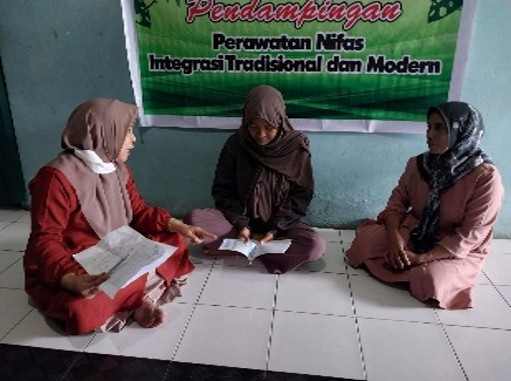
Postpartum care is a crucial period in maintaining maternal health after childbirth. On Ternate Island, traditional postpartum care practices are still strongly maintained, with traditional birth attendants (mama biang) playing a central role in their implementation. However, some traditional practices can pose potential health risks if not balanced with modern medical knowledge. This situation underpins the implementation of a community service program aimed at empowering mama biang by improving health literacy and integrating traditional and modern practices in postpartum care. The program, conducted in June 2024, involved 20 participants in the Ternate Island District, primarily targeting mama biang. This program included: (a) education and training in culture-based health literacy, (b) mentoring in integrative practices in accordance with modern health principles without negating local values, and (c) the development and distribution of educational booklets. The results demonstrated increased knowledge and behavioral changes among mama biang in providing safer, cleaner, and evidence-based postpartum care. Furthermore, integrative health literacy education materials were produced that can be sustainably used in other regions. This program strengthens the synergy between local wisdom and modern health practices to improve maternal and infant health in island regions.
References
Abdul Ghani, R., & Salehudin, S. (2018). Traditional Belief and Practice on Postpartum Recovery among Mothers in East Coast of Peninsular Malaysia. MATEC Web of Conferences, 150. https://doi.org/10.1051/matecconf/201815005067
Asmuji., & Diyan, Indriyani. (2014). Model Edukasi Postnatal Melalui Pendekatan FCMC. Keperawatan, 5(2), 128–141.
Astri, H., & Alhadar, F. (2018). Rorano Ramuan Percepat Proses Persalinan Pada Etnik Ternate. Jurnal Riset Kesehatan, 7(1), 25. https://doi.org/10.31983/jrk.v7i1.3134
Barnes, L. A. J., Rolfe, M. I., Barclay, L., McCaffery, K., & Aslani, P. (2022). Demographics, health literacy and health locus of control beliefs of Australian women who take complementary medicine products during pregnancy and breastfeeding: A cross-sectional, online, national survey. Health Expectations, 25(2), 667–683. https://doi.org/10.1111/hex.13414
Bazzano, A. N., Stolow, J. A., Duggal, R., Oberhelman, R. A., & Var, C. (2020). Warming the postpartum body as a form of postnatal care: An ethnographic study of medical injections and traditional health practices in Cambodia. PLoS ONE, 15(2). https://doi.org/10.1371/journal.pone.0228529
Bennardo, G. (2018). Cultural Models Theory. Anthropology News, 59(4), e139–e142. https://doi.org/10.1111/an.919
Coast, E., Jones, E., Lattof, S. R., & Portela, A. (2016). Effectiveness of interventions to provide culturally appropriate maternity care in increasing uptake of skilled maternity care: A systematic review. Health Policy and Planning, 31(10), 1479–1491. https://doi.org/10.1093/heapol/czw065
Coutinho, E., Amaral, S., Parreira, M. V. B. de C., Chaves, C. B., Amaral, O., & Nelas, P. (2019). Nurses-puerperal mothers interaction: Searching for cultural care. Revista Brasileira de Enfermagem, 72(4), 910–917. https://doi.org/10.1590/0034-7167-2018-0216
Ehrari, H., Tordrup, L., & Müller, S. (2022). The Digital Divide in Healthcare: A Socio-Cultural Perspective of Digital Literacy. Proceedings of the 55th Hawaii International Conference on System Sciences, 7, 4097–4106. https://doi.org/10.24251/hicss.2022.499
El Ayadi, A. M., Duggal, M., Bagga, R., Singh, P., Kumar, V., Ahuja, A., Kankaria, A., Basavarajappa, D. H., Kaur, J., Sharma, P., Gupta, S., Pendse, R. S., Weil, L., Swendeman, D., & Diamond-Smith, N. G. (2022). A Mobile Education and Social Support Group Intervention for Improving Postpartum Health in Northern India: Development and Usability Study. JMIR Formative Research, 6(6), 1–17. https://doi.org/10.2196/34087
Kassie, B., Ahmed, B., & Degu, G. (2022). Predictors of time to recovery from postpartum hemorrhage in Debre Markos comprehensive specialized hospital, Northwest, Ethiopia, 2020/21. BMC Pregnancy and Childbirth, 22(1). https://doi.org/10.1186/s12884-022-04834-5
Kersh, E. N., & Workowski, K. A. (2020). Evidence Review for Centers for Disease Control and Prevention Guidance Development on Laboratory Testing to Detect Treponema pallidum Infection (Syphilis). Clinical Infectious Diseases, 71, S1–S3. https://doi.org/10.1093/cid/ciaa348
Mariyati, & Tumansery, G. S. (2018). Perawatan Diri Berbasis Budaya Selama Masa Nifas Pada Ibu Postpartum. Jurnal Ilmu Keperawatan, 6(1), 47–56.
Rahayu., S., I, Mudatsir, Hasballah., K. (2017). Faktor Budaya Dalam Perawatan Ibu Nifas. Jurnal Ilmu Keperawatan, 5(1), 36–49.
Ramulondi, M., de Wet, H., & Ntuli, N. R. (2021). Traditional food taboos and practices during pregnancy, postpartum recovery, and infant care of Zulu women in northern KwaZulu-Natal. Journal of Ethnobiology and Ethnomedicine, 17(1), 1–19. https://doi.org/10.1186/s13002-021-00451-2
Reiza, Y. (2018). Budaya Nifas Masyarakat Indonesia, Perlu Tidak Dipertahankan? eJournal Kedokteran Indonesia, 6(1), 1–3. https://doi.org/10.23886/ejki.6.8060.
Safitri, F., Rahmi, N., Melati, K., & Marniati, M. (2020). Perilaku Ibu Terhadap Tradisi Perawatan Masa Nifas Di Wilayah Kerja Puskesmas Jeulingke Kota Banda Aceh. Journal of Healthcare Technology and Medicine, 6(1), 538. https://doi.org/10.33143/jhtm.v6i1.864
Sanchez-Garcia, J. C., Aguilar-Cordero, M. J., Montiel-Troya, M., Marín-Jiménez, A. E., Cortes-Martin, J., & Rodriguez-Blanque, R. (2022). Quality of Life in the Postpartum Recovery of Women Who Practice Hypopressive Exercise: Randomized Clinical Trial. Journal of Clinical Medicine, 11(19), 5592. https://doi.org/10.3390/jcm11195592
Saptandari, P. (2016). Nilai-Nilai dan Praktek Budaya Tentang Pemenuhan Kesehatan Perempuan Bawean. BioKultur, V No. 1(1), 36–60.
Sellevold, V. L., Hamre, L. L., & Bondas, T. E. (2022). A meta-ethnography of language challenges in midwifery care. European Journal of Midwifery, 6(July), 1–13. https://doi.org/10.18332/ejm/147994
Wagner, T., Stark, M., & Raines Milenkov, A. (2020). What About Mom? Health Literacy and Maternal Mortality. Journal of Consumer Health on the Internet, 24(1), 50–61. https://doi.org/10.1080/15398285.2019.1710980
Downloads
Published
How to Cite
Issue
Section
License
Copyright (c) 2026 Nurdiana Lante (Author); Triany L. Pelu

This work is licensed under a Creative Commons Attribution-ShareAlike 4.0 International License.
Authors who publish with Poltekita: Jurnal Pengabdian Masyarakat agree to the following terms:
- Authors retain copyright and grant the journal right of first publication with the work simultaneously licensed under a Creative Commons Attribution License (CC BY-SA 4.0) that allows others to share the work with an acknowledgment of the work's authorship and initial publication in this journal.
- Authors are able to enter into separate, additional contractual arrangements for the non-exclusive distribution of the journal's published version of the work (e.g., post it to an institutional repository or publish it in a book), with an acknowledgment of its initial publication in this journal.
- Authors are permitted and encouraged to post their work online (e.g., in institutional repositories or on their website) prior to and during the submission process, as it can lead to productive exchanges, as well as earlier and greater citation of published work.

This work is licensed under a Creative Commons Attribution-Share Alike 4.0 International License
You are free to:
- Share, copy and redistribute the material in any medium or format
- Adapt, remix, transform, and build upon the material for any purpose, even commercially.
- The licensor cannot revoke these freedoms as long as you follow the license terms.
1.png)