Pemberdayaan Masyarakat Dusun Bayor-bayor dalam Pengolahan Sampah Organik Rumah Tangga Menggunakan Komposter Ember Tumpuk
Empowering the Bayor-Bayor Hamlet Community to Manage Household Organic Waste Using Stacked Bucket Composters

https://doi.org/10.33860/pjpm.v7i1.4312
Keywords:
household organic waste, stacked bucket composter, waste processingAbstract
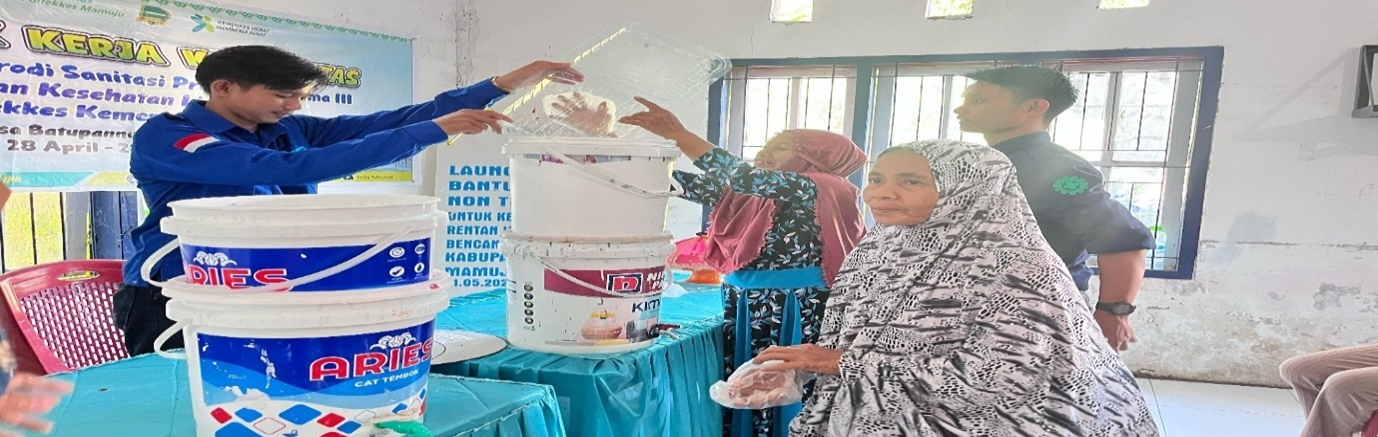
This community service activity aimed to improve the knowledge and skills of residents in Bayor-Bayor Hamlet, Batupannu Village, in managing household organic waste into compost using stacked buckets. The implementation method consisted of several stages. The initial reflection stage involved coordination with the village government and data collection to identify the main problems. The second stage included participatory planning through Focus Group Discussions (FGDs) with the community to determine the intervention model and activity schedule. The third stage was the implementation phase, covering education, demonstrations, and hands-on compost-making using a participatory training approach. Monitoring was conducted through mentoring and regular visits to evaluate the implementation process. The results showed a significant increase in participants’ knowledge, with the average pre-test post-test score rising from 41.8 (min: 13.3; max: 73.3) to 66.2 (min: 46.7; max: 86.7), and the establishment of two model households independently managing organic waste. In conclusion, this activity effectively enhanced participants’ understanding of waste management. Motivation, self-confidence, and continuous support were key factors in the successful adoption of the technology. To ensure program sustainability, it is recommended to establish local environmental cadres supported by village policies through regulations and incentives.
References
Aisyiah, N., Islam, F., Ashari, A. E., Ahmad, H., Sanitasi, P. D., Mamuju, P. K., & Barat, S. (2024). Kualitas Sanitasi Higiene dengan Peningkatan Frekuensi Diare pada Balita. Health, Safety, and Environment, 3(1), 1–9. https://ejournal.upnvj.ac.id/HSE/article/view/9441/3210
Armadi, N. M. (2021). Peran Serta Masyarakat dalam Pengelolaan Sampah sebagai Kunci Keberhasilan dalam Mengelola Sampah. Jurnal Ilmu Sosial Dan Ilmu Politik Sekolah Tinggi Ilmu Sosial Politik WIra Bhakti, 35(1), 9–24. https://api.semanticscholar.org/CorpusID:236409187
Ashari, A. E., & Islam, F. (2023). Pelatihan Pengelolaan Sampah Rumah Tangga dengan Metode Emo Demo. Community Development Journal : Jurnal Pengabdian Masyarakat, 4(2), 2727–2734. https://journal.universitaspahlawan.ac.id/index.php/cdj/article/view/14619/11462
Azzaki, D. A., Jati, D. R., Sulastri, A., Irsan, R., & Jumiati, J. (2022). Analisis Pemanfaatan Sampah Plastik dengan Metode Buang, Pisah, dan Untung Menggunakan Sistem Barcode. Jurnal Ilmu Lingkungan, 20(2), 252–262. https://doi.org/10.14710/jil.20.2.252-262
Diana, Mukti, N. I. F., & Purwaningrum, Y. (2024). Pemilahan Sampah sebagai Upaya Pengelolaan Sampah Mandiri di Lingkungan Pondok Pesantren Krapyak Yogyakarta. Prosiding Seminar Nasional Hasil Penelitian Dan Pengabdian Masyarakat Dengan Tema “Pengembangan Energi Baru Dan Terbarukan Untuk Lingkungan Berkelanjutan” - Diseminasi Pengabdian, 209–2018. https://dspace.uii.ac.id/handle/123456789/53474
Firmansyah, A., & Taufiq, N. (2020). Sinergi Program Pemberdayaan Masyarakat Berbasis Lingkungan Melalui Inovasi Maggot. Jurnal Resolusi Konflik, CSR, Dan Pemberdayaan (CARE), 5(1), 63–70. http://jurnal.unsil.ac.id/index.php/jipp/article/viewFile/2620/1744
Indriani, Ashari, A. E., Islam, F., & Adiningsih, R. (2023). Efektivitas Kombinasi Mikroorganisme Lokal (Mol) Nasi Basi dan Kulit Pisang Kepok (Musa acuminata) sebagai Aktivator Pembuatan Kompos. Jurnal Kesehatan Lingkungan Mapaccing, 1(1), 30–39. https://jurnal.poltekkesmamuju.ac.id/index.php/mpc/article/view/1117/278
Khoiriyah, H. (2021). Analisis Kesadaran Masyarakat Akan Kesehatan terhadap Upaya Pengelolaan Sampah di Desa Tegorejo Kecamatan Pegandon Kabupaten Kendal. Indonesian Journal of Conservation, 10(1), 13–20. https://journal.unnes.ac.id/nju/index.php/ijc/article/view/30587
KLHK. (2022). SIPSN - Sistem Informasi Pengelolaan Sampah Nasional. https://sipsn.menlhk.go.id/sipsn/public/data/timbulan
Mahyudin, R. P. (2017). Kajian Pengelolaan Sampah dan Dampak Lingkungan di TPA (Tempat Pemrosesan Akhir). Jukung Jurnal Teknik Lingkungan, 3(1), 66–74. https://ppjp.ulm.ac.id/journal/index.php/jukung/article/download/3201/2745
Makbullah, A., Irmayanti, D., Abriansyahs, & Hotimah, O. (2025). Evaluasi Kebijakan Lingkungan Indonesia dan Malaysia dalam Pengelolaan Sampah Perkotaan. Jurnal Environmental Science, 8(1), 16–27. https://ojs.unm.ac.id/JES/article/download/71988/33610
Mappau, Z., & Islam, F. (2022). Pelatihan Pengelolaan Sampah Rumah Tangga dengan Metode Komposting Takakura. Poltekita: Jurnal Pengabdian Masyarakat, 3(2), 258–267. https://doi.org/10.33860/pjpm.v3i2.1077
Marlina. (2024). Pengelolaam Sampah Berbasis Masyarakat untuk Mendukung SDGs Tahun 2030 ( Tujuan 11 - Kota dan Permukiman yang Berkelanjutan ) di Kota Makassar. Geosfera: Jurnal Penelitian Geografi (GeoJPG), 3(2), 111–120. https://ejurnal.ung.ac.id/index.php/geojpg/article/view/28532
Nurikah, Nurikah, Jazuli, E Rakhmat, Furqon, & Eki. (2022). Waste Management Governance Based On Law Number 18 Of 2008 Of Waste Management Of Waste Based Citizen Participation In The Serang City. Gorontalo Law Review, 5(2), 434–442. https://doi.org/https://doi.org/10.32662/golrev.v5i2.2201
Nurita, Islam, F., Akbar, F., & Mubarak, F. (2023). Efektivitas Komposter Takakura dan Komposter Sederhana dalam Pembuatan Kompos Sampah Organik. Jurnal Sanitasi Profesional Indonesia, 4(1), 21–31. https://poltekkesbengkulu.ac.id/ojs/index.php/sanpro/article/view/383/236
Nurmaisyah, F., & Susilawati, S. (2022). Pengetahuan Masyarakat dalam Pengelolaan Sampah Rumah Tangga di Kecamatan Percut Sei Tuan. PubHealth Jurnal Kesehatan Masyarakat, 1(1), 91–96. https://doi.org/10.56211/pubhealth.v1i1.47
Nurul Ilma, Andi Nuddin, & Makhrajani Majid. (2021). Perilaku Warga Masyarakat dalam Pengelolaan Sampah Rumah Tangga Di Zona Pesisir Kota Parepare. Jurnal Ilmiah Manusia Dan Kesehatan, 4(1), 24–37. https://doi.org/10.31850/makes.v4i1.367
Putri, S. D., Addini, J. T., & Heriyanti, A. P. (2022). Jeonju vs Semarang : Peran Serta Masyarakat Dalam Pengelolaan Sampah. Proceeding Seminar Nasional IPA XII, 77–83. https://proceeding.unnes.ac.id/snipa/article/view/1339
Razak, M. R. R., Syarifuddin, H., Fitriyani, Jabbar, A., & Ikbal, M. (2020). Kesadaran Masyarakat dan Polusi Sampah. NUSANTARA : Jurnal Ilmu Pengetahuan Sosial, 7(3), 545–554. http://jurnal.um-tapsel.ac.id/index.php/nusantara/article/view/1872
Sidebang, C. P. (2022). Analisis Dampak Timbunan Sampah Di Sekitar Lokasi Tempat Pembuangan Akhir (TPA) Tanjung Pinggir Kota Pematangsiantar. Jurnal Ilmiah Multidisiplin, 1(5), 973–983. https://journal-nusantara.com/index.php/JIM/article/download/220/182/430
Sucita, A., Lestari, D., & Walid, A. (2020). Pengelolaan Sampah Rumah Tangga di Kelurahan Bentiring - Kecamatan Muara Bangkahulu - Bengkulu. Spizaetus : Jurnal Biologi Dan Pendidikan Biologi, 1(3), 1–11. https://spizaetus.nusanipa.ac.id/index.php/spizaetus/article/view/18
Wibowo, R. H., Darwis, W., Nesbah, N., Taifur, A., Aggraini, P. L., Safniyeti, S., Wahyuni, R., Sinaga, L. R., & Siddiq, Y. U. Al. (2025). Pelatihan Pembuatan Teknologi Tepat Guna Komposter Ember Tumpuk Sebagai Upaya Pengelolahan Limbah Rumah Tangga Bagi Masyarakat Kelurahan Sidomulyo, Kota Bengkulu. Martabe : Jurnal Pengabdian Kepada Masyarakat, 8(4), 1658–1667. https://jurnal.um-tapsel.ac.id/index.php/martabe/article/view/18909/pdf
Zahra, A. S., Islam, F., Ahmad, H., & Ashari, A. E. (2024). No Title. Jurnal Kesehatan Lingkungan Mapaccing, 2(1), 15. https://doi.org/10.33490/mpc.v2i1.1155
Downloads
Published
How to Cite
Issue
Section
License
Copyright (c) 2026 Fahrul Islam, Haeranah Ahmad, Fajar Akbar (Author)

This work is licensed under a Creative Commons Attribution-ShareAlike 4.0 International License.
Authors who publish with Poltekita: Jurnal Pengabdian Masyarakat agree to the following terms:
- Authors retain copyright and grant the journal right of first publication with the work simultaneously licensed under a Creative Commons Attribution License (CC BY-SA 4.0) that allows others to share the work with an acknowledgment of the work's authorship and initial publication in this journal.
- Authors are able to enter into separate, additional contractual arrangements for the non-exclusive distribution of the journal's published version of the work (e.g., post it to an institutional repository or publish it in a book), with an acknowledgment of its initial publication in this journal.
- Authors are permitted and encouraged to post their work online (e.g., in institutional repositories or on their website) prior to and during the submission process, as it can lead to productive exchanges, as well as earlier and greater citation of published work.

This work is licensed under a Creative Commons Attribution-Share Alike 4.0 International License
You are free to:
- Share, copy and redistribute the material in any medium or format
- Adapt, remix, transform, and build upon the material for any purpose, even commercially.
- The licensor cannot revoke these freedoms as long as you follow the license terms.
1.png)