Peningkatan Pengetahuan Pelajar SMA melalui Sosialisasi dan Edukasi Bahan Tambahan Pangan Berbahaya dalam Jajanan Sekolah di Kota Palu

https://doi.org/10.33860/pjpm.v6i2.3843
Keywords:
harmful food additives, snacks, studentsAbstract
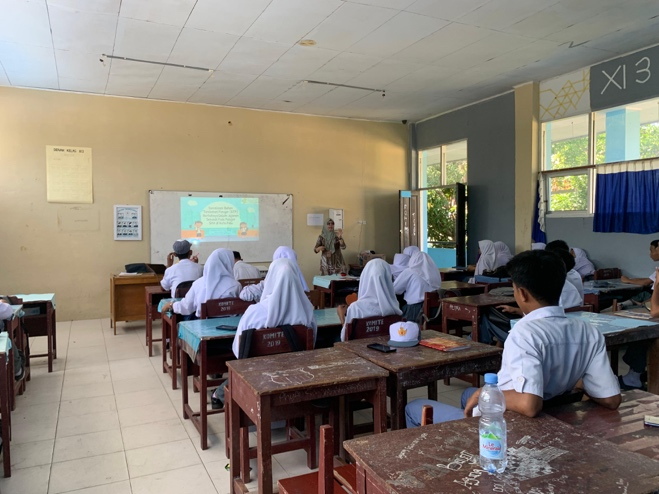
Food Additives (FDA) are certain ingredients added to food to make it look attractive and have a longer shelf life. FDA can be dangerous if used in food in doses greater than the specified standard or consumption limit. Hazardous FDA are usually found in school snacks, so education is needed to increase students' knowledge to protect them from dangerous FDA. The purpose of this community service is to increase students' understanding and knowledge regarding dangerous FDA in school snacks. This activity was carried out at SMA Negeri 7 Palu with a total of 59 participants. The implementation of the activity was in the form of providing education about dangerous FDA in school snacks to students using lecture methods and leaflet distribution. Knowledge measurements were carried out before and after the education. The results of the pre-post test showed that there was an effect of providing education on students' knowledge with a significance value of α = 0.00 with an increase in knowledge of 25.4%. The increase in students' knowledge is expected to have implications for students' attitudes in choosing safe foods for consumption.
References
Amalia, A., Okzelia, S. D., Amirullah, F., Kusumawinahyu, R., Pratiwi, D. W., & Mar’atun, S. (2021). Education On The Risks Of Using Hazardous Additives In Snacks For Students At Margahayu Ii Elementary School In Bekasi City. Darmabakti Cendekia: Journal of Community Service and Engagements, 01, 1–6. https://doi.org/10.20473/dc.v3i1.2021.1-6
Anggrahini, S. (2015). Kemanan Pangan. Jakarta: PT. Kasinus.
Arisanti, D., Rahmawati, & Rustiah, W. O. (2023). Peningkatan Pengetahuan Siswa Melalui Edukasi Tentang Bahan Pengawet Yang Berbahaya Pada Makanan Jajanan Di Sman 14 Kota Makassar (Vol. 4). Makassar.
BPOM. (2021a). Bahan Tambahan Yang Dilarang Digunakan Dalam Produk Pangan. Retrieved May 22, 2023, from Direktorat Standardisasi Pangan Olahan website: https://standarpangan.pom.go.id/berita/bahan-tambahan-yang-dilarang-digunakan-dalam-produk-pangan
BPOM. (2021b). Pedoman Pangan Jajanan Anak Sekolah Untuk Pencapaian Gizi Seimbang. Jakarta: Badan Pengawas Obat dan Makanan RI.
Cahyadi, W. (2006). Analisis & aspek kesehatan bahan tambahan pangan. Jakarta: Bumi Aksara.
Ermawati, F. U., Prahani, B. K., Dzulkiflih, Yantidewi, M., & Zainuddin, A. (2021). The Performance of Turmeric Paper as an Indicator of The Borax Content in Crackers. Journal of Physics: Conference Series, 2110(1), 012014. https://doi.org/10.1088/1742-6596/2110/1/012014
Eurika, N., & Hapsari, A. I. (2020). Edukasi Dampak Penggunaan Bahan Tambahan Pangan Berbahaya untuk Kesehatan Pada Kelompok Pengajian ‘Aisyiyah Desa Kertosari Jember. Pengolahan Limbah Asap Hasil Pembakaran Arang Batok Kelapa Menjadi Liquid Smoke Untuk Bahan Pengawet Alami Ikan Asap Di Kota Probolinggo, 4(2011), 24–33.
Gurusinga, R., Sembiring, I. M., & Br Ginting Munthe, N. (2022). Behavior Of Elementary Children Before And After Education About The Dangerous Snacking. Jurnal Pengmas Kestra (JPK), 2(1), 53–57. https://doi.org/10.35451/jpk.v2i1.1138
Harahap, F. S., Lubis, L. T., Pohan, H. M., Azizah, J., & Nurmi, A. (2022). Test Of Borax And Formaline On Snacks At Muhammadiyah Elementary School Padangsidimpuan City. Biolink (Jurnal Biologi Lingkungan Industri Kesehatan), 9(1), 33–41. https://doi.org/10.31289/biolink.v9i1.6967
Ihsan, B. R. P., Putri, A. R., Yurina, V., Puspita, O. E., & Shalas, A. F. (2023). Penyuluhan Mengenai Bahan Tambahan Pangan Pengawet dan Pewarna kepada Siswa SMP Singosari Kabupaten Malang. Darmabakti : Jurnal Pengabdian Dan Pemberdayaan Masyarakat, 4(2), 208–214. https://doi.org/10.31102/darmabakti.2023.4.2.208-214
Julaeha, L., Nurhayati, A., & Mahmudatusa’adah, A. (2016). Penerapan Pengetahuan Bahan Tambahan Pangan Pada Pemilihan Makanan Jajanan Mahasiswa Pendidikan Tata Boga UPI. Jurnal Media Pendidikan, Gizi Dan Kuliner, 5(1).
Nur, H. H., & Suryani, D. (2012). Analisis Kandungan Nitrit dalam Sosis Pada Distributor Sosis di Kota Yogyakarta Tahun 2011. Jurnal Kesmas UAD, 6(1), 1–12.
Octaviana, A. (2011). Pengetahuan, Sikap Dan Praktek Gizi Siswa Sekolah Menengah Pertama Terhadap Penggunaan Bahan Tambahan Pangan (BTP) Pada Makanan Jajanan. Institut Pertanian Bogor, Bogor.
Puspawiningtyas, E., Pamungkas, R. B., & Hamad, A. (2017). Upaya Meningkatkan Pengetahuan Bahan Tambahan Pangan Melalui Pelatihan Deteksi Kandungan Formalin Dan Boraks. JPPM (Jurnal Pengabdian Dan Pemberdayaan Masyarakat), 1(1). https://doi.org/10.30595/jppm.v1i1.1220
Safitriani, U., Suryani, D., & Mulasari, S. A. (2023). Analysis of Factors That Influence Snack Food Selection Behavior in High School Students. 6(6), 605–611. https://doi.org/10.32832/pro
Santoso, D., Rahayu, A. A., Herawati, A., Salsabillah, S., Damayanti, S., & Sulistiyorini, D. (2024). Kandungan Formalin dan Boraks pada Makanan Jajanan. Journal of Public Health Education, 3(3), 82–90. https://doi.org/10.53801/jphe.v3i3.186
Sari, S. K. (2017). Penggunaan Bahan Tambahan Pangan Oleh Parapedagang Jajanan Di Sekolah Dasarkecamatan Padang Utara. Padang.
Wahyudi, J. (2017). Mengenali Bahan Tambahan Pangan Berbahaya : Ulasan. Jurnal Litbang: Media Informasi Penelitian, Pengembangan Dan IPTEK, 13(1), 3–12. https://doi.org/10.33658/jl.v13i1.88
Widyaningsih, T. D., & Murtini, E. S. (2006). Alternatif pengganti formalin pada produk pangan. Surabaya: Trubus Agrisarana.
Yuet-Wan Lok, K., Chung, W.-Y., Benzie, I. F. F., & Woo, J. (2010). Colour additives in snack foods consumed by primary school children in Hong Kong. Food Additives and Contaminants: Part B, 3(3), 148–155. https://doi.org/10.1080/19393210.2010.509815
Downloads
Published
How to Cite
Issue
Section
License
Copyright (c) 2025 Diah Ayu Hartini, Bahja, Ansar, Siti Hadijah Batjo, Ummu Aiman, Nurulfuadi (Author)

This work is licensed under a Creative Commons Attribution-ShareAlike 4.0 International License.
Authors who publish with Poltekita: Jurnal Pengabdian Masyarakat agree to the following terms:
- Authors retain copyright and grant the journal right of first publication with the work simultaneously licensed under a Creative Commons Attribution License (CC BY-SA 4.0) that allows others to share the work with an acknowledgment of the work's authorship and initial publication in this journal.
- Authors are able to enter into separate, additional contractual arrangements for the non-exclusive distribution of the journal's published version of the work (e.g., post it to an institutional repository or publish it in a book), with an acknowledgment of its initial publication in this journal.
- Authors are permitted and encouraged to post their work online (e.g., in institutional repositories or on their website) prior to and during the submission process, as it can lead to productive exchanges, as well as earlier and greater citation of published work.

This work is licensed under a Creative Commons Attribution-Share Alike 4.0 International License
You are free to:
- Share, copy and redistribute the material in any medium or format
- Adapt, remix, transform, and build upon the material for any purpose, even commercially.
- The licensor cannot revoke these freedoms as long as you follow the license terms.
1.png)