Micronutrient Supplementation and Its Association with Prevention of Postpartum Blues and Breastfeeding Outcomes: A Prospective Cohort Study in Balikpapan City

https://doi.org/10.33860/jbc.v8i1.4348
Keywords:
Postpartum Blues, Micronutrient Supplementation, Postpartum Depression, Breastfeeding Success, Maternal Mental HealthAbstract
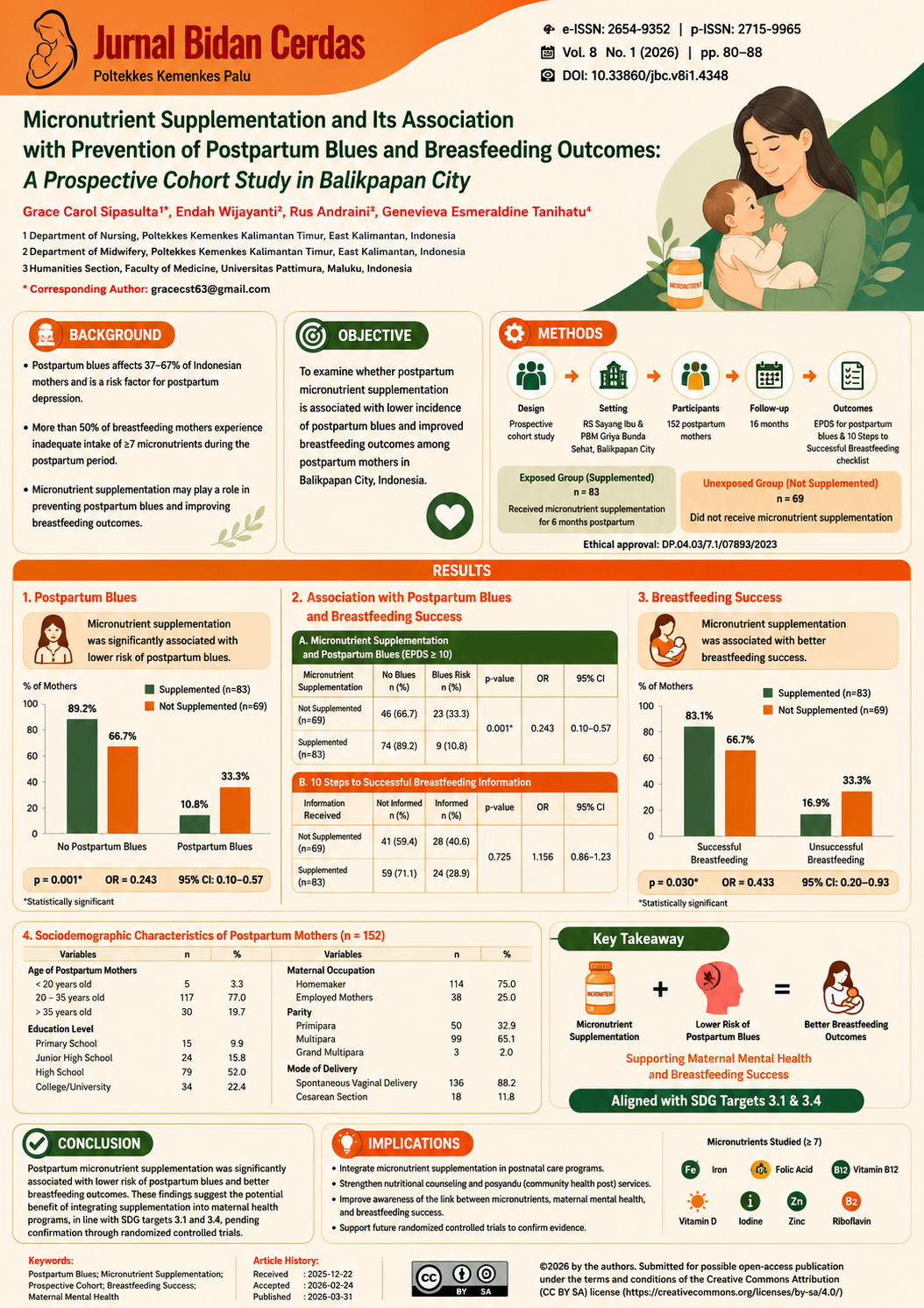
Background: Postpartum blues affects 37–67% of Indonesian mothers, yet the role of micronutrient supplementation as a preventive strategy remains underexplored. This study examined whether postpartum micronutrient supplementation was associated with lower incidence of postpartum blues and improved breastfeeding outcomes among postpartum mothers in Balikpapan, Indonesia.
Methods: A prospective cohort study followed 152 postpartum mothers at RS Sayang Ibu and PBM Griya Bunda Sehat, Balikpapan City, for 16 months. The exposed group (n=83) received micronutrient supplementation for six months postpartum, while the unexposed group (n=69) did not. Outcomes were assessed using the Edinburgh Postnatal Depression Scale (EPDS) and 10 Steps to Successful Breastfeeding checklist. Ethical approval was obtained (DP.04.03/7.1/07893/2023).
Results: Among supplemented mothers, 89.2% experienced no postpartum blues compared with 66.7% in the non-supplemented group. Micronutrient supplementation was significantly associated with reduced postpartum blues risk (p=0.001; OR=0.243; 95%CI: 0.10–0.57). Supplementation was also associated with improved breastfeeding success (p=0.030; OR=0.433; 95%CI: 0.20–0.93), with 83.1% achieving successful breastfeeding.
Conclusion: Postpartum micronutrient supplementation was significantly associated with lower risk of postpartum blues and better breastfeeding outcomes. These findings suggest the potential benefit of integrating supplementation into maternal health programs, in line with SDG targets 3.1 and 3.4, pending confirmation through randomized controlled trials.
Downloads
References
A. Di Florio, K. Putnam, M. Altemus, et al. (2017). The impact of education, country, race and ethnicity on the self- report of postpartum depression using the Edinburgh Postnatal Depression Scale. Physiology & Behavior, 176(10), 139–148. https://doi.org/10.1017/S0033291716002087.The
Ahmad, M., Sechi, C., & Vismara, L. (2024). Advanced Maternal Age: A Scoping Review about the Psychological Impact on Mothers, Infants, and Their Relationship. Behavioral Sciences, 14. https://doi.org/10.3390/bs14030147
Ahoya, B., Kavle, J., Kiige, L., Gathi, C., Samburu, B., Maina, L., … Codjia, P. (2022). How COVID‐19 affected food systems, health service delivery and maternal and infant nutrition practices: Implications for moving forward in Kenya. Maternal & Child Nutrition, 19. https://doi.org/10.1111/mcn.13466
Amer, S. A., Zaitoun, N. A., Abdelsalam, H. A., Abbas, A., Ramadan, M. S., Ayal, H. M., … Al-Shroby, W. A. (2024). Exploring predictors and prevalence of postpartum depression among mothers: Multinational study. BMC Public Health, 24(1), 1–15. https://doi.org/10.1186/s12889-024-18502-0
Ay, Ö. P., & Aktas, S. (2021). The effect of maternal functional and postpartum depression status on breastfeeding self-efficacy of the mothers: A cross-sectional study. Health Care for Women International, 45, 236–250. https://doi.org/10.1080/07399332.2021.1973008
Balikpapan Health Office. (2025). Dinkes Balikpapan Luncurkan Program GASPOL Tingkatkan Kinerja Posyandu. Fokus Borneo, pp. 1–9. Retrieved from https://fokusborneo.com/daerah/2025/05/16/dinkes-balikpapan-luncurkan-program-gaspol-tingkatkan-kinerja-posyandu/
Balikpapan Statistics. (2025). Peringatan Hari Posyandu Nasional 2025. Berita Dan Siaran Pers, Badan Pusat Statistik Kota Balikpapan, pp. 2–6. https://balikpapankota.bps.go.id/id/news/2025/04/29/278/commemoration-of-national-posyandu-day-2025.html
Brunton, R., Simpson, N., & Dryer, R. (2020). Pregnancy-related anxiety, perceived parental self-efficacy and the influence of parity and age. International Journal of Environmental Research and Public Health, 17(18), 1–17. https://doi.org/10.3390/ijerph17186709
Carretero-Krug, A., Montero-Bravo, A., Morais-Moreno, C., Puga, A., Samaniego-Vaesken, M., Partearroyo, T., & Varela-Moreiras, G. (2024). Nutritional Status of Breastfeeding Mothers and Impact of Diet and Dietary Supplementation: A Narrative Review. Nutrients, 16. https://doi.org/10.3390/nu16020301
Chechko, N., Losse, E., Frodl, T., & Nehls, S. (2023). Baby blues, premenstrual syndrome and postpartum affective disorders: intersection of risk factors and reciprocal influences. BJPsych Open, 10. https://doi.org/10.1192/bjo.2023.612
Crawford, K. A., Gallagher, L. G., Baker, E. R., Karagas, M. R., & Romano, M. E. (2023). Predictors of Breastfeeding Duration in the New Hampshire Birth Cohort Study. Maternal and Child Health Journal, 27(8), 1434–1443. https://doi.org/10.1007/s10995-023-03714-4
Daniels, L., Gibson, R., Diana, A., Haszard, J., Rahmannia, S., Luftimas, D., … Houghton, L. (2019). Micronutrient intakes of lactating mothers and their association with breast milk concentrations and micronutrient adequacy of exclusively breastfed Indonesian infants. The American Journal of Clinical Nutrition, 110, 391–400. https://doi.org/10.1093/ajcn/nqz047
Dehghan-Banadaki, S., Hosseinzadeh, M., Madadizadeh, F., & Mozaffari-Khosravi, H. (2023). Empirically derived dietary patterns and postpartum depression symptoms in a large sample of Iranian women. BMC Psychiatry, 23(1), 1–11. https://doi.org/10.1186/s12888-023-04910-w
Fish-Williamson, A., & Hahn-Holbrook, J. (2023). Nutritional factors and cross-national postpartum depression prevalence: an updated meta-analysis and meta-regression of 412 studies from 46 countries. Frontiers in Psychiatry, 14. https://doi.org/10.3389/fpsyt.2023.1193490
França, B. F. R., De Aguiar, R. R. C., Cordeiro, K. I. C., De Araujo, L. V. L., Silva, L. S. R., Martins, A. J. M., & De Paula Santana Da Silva, T. (2023). Postpartum Depression: Impact On The Long-Term Mental Health Of Mothers And Children. International Journal of Human Sciences Research. https://doi.org/10.22533/at.ed.5583442321113
Gibson, R. S., Rahmannia, S., Diana, A., Leong, C., Haszard, J. J., Hampel, D., … Houghton, L. A. (2020). Association of maternal diet, micronutrient status, and milk volume with milk micronutrient concentrations in Indonesian mothers at 2 and 5 months postpartum. American Journal of Clinical Nutrition, 112(4), 1039–1050. https://doi.org/10.1093/ajcn/nqaa200
Irmawati, D. and F. E. (2023). Landscape Analysis and Recommendations. UNICEF Indonesia. Retrieved from https://www.unicef.org/indonesia/media/21761/file/Maternal nutrition in Indonesia - Landscape analysis and recommendation.pdf.pdf
Jin, J., Bao, Y., Han, Y., Zhang, H., Zheng, Q., Zhao, X., … Wang, C. (2025). A study on the factors influencing pregnancy-related anxiety and its correlation with family functioning and social support among primiparous pregnant women in early pregnancy. Journal of Obstetrics and Gynaecology Research, 51(7), e16333. https://doi.org/10.1111/jog.16333
Jouanne, M., Oddoux, S., Noël, A., & Voisin‐Chiret, A. (2021). Nutrient Requirements during Pregnancy and Lactation. Nutrients, 13. https://doi.org/10.3390/nu13020692
Manurung, S., & Setyowati, S. (2021). Development and validation of the maternal blues scale through bonding attachments in predicting postpartum blues. Malaysian Family Physician, 16(1), 64–74. https://doi.org/10.51866/OA1037
Matsumura, K., Hamazaki, K., Tsuchida, A., Kasamatsu, H., Inadera, H., Kamijima, M., … Katoh, T. (2019). Education level and risk of postpartum depression: Results from the Japan Environment and Children’s Study (JECS). BMC Psychiatry, 19(1), 1–11. https://doi.org/10.1186/s12888-019-2401-3
Papadopoulou, S.K.; Pavlidou, E.; Dakanalis, A. . et al. (2023). Postpartum Depression Is Associated with Maternal. MDPI Journals. https://doi.org/https://doi.org/10.3390/nu15173853
Rupanagunta, G. P., Nandave, M., Rawat, D., Upadhyay, J., Rashid, S., & Ansari, M. N. (2023). Postpartum depression: aetiology, pathogenesis and the role of nutrients and dietary supplements in prevention and management. Saudi Pharmaceutical Journal, 31(7), 1274–1293. https://doi.org/10.1016/j.jsps.2023.05.008
Tosto, V., Ceccobelli, M., Lucarini, E., Tortorella, A., Gerli, S., Parazzini, F., & Favilli, A. (2023). Personalized Medicine Maternity Blues: A Narrative Review. Journal of Personalized Medicine. Retrieved from https://doi.org/10.3390/jpm13010154
Vega, A. C., Maguiña, J., Soto, A., Lama-Valdivia, J., & López, L. C. (2021). Cross-sectional studies. Revista de La Facultad de Medicina Humana. https://doi.org/10.25176/rfmh.v21i1.3069
Downloads
Published
How to Cite
Issue
Section
License
Copyright (c) 2026 Grace Carol Sipasulta, Endah Wijayanti, Rus Andraini, Genevieva Esmeraldine Tanihati (Author)

This work is licensed under a Creative Commons Attribution-ShareAlike 4.0 International License.
Authors who publish with Jurnal Bidan Cerdas agree to the following terms:
- Authors retain copyright and grant the journal right of first publication with the work simultaneously licensed under a Creative Commons Attribution License (CC BY-SA 4.0) that allows others to share the work with an acknowledgment of the work's authorship and initial publication in this journal.
- Authors are able to enter into separate, additional contractual arrangements for the non-exclusive distribution of the journal's published version of the work (e.g., post it to an institutional repository or publish it in a book), with an acknowledgment of its initial publication in this journal.
- Authors are permitted and encouraged to post their work online (e.g., in institutional repositories or on their website) prior to and during the submission process, as it can lead to productive exchanges, as well as earlier and greater citation of published work.

This work is licensed under a Creative Commons Attribution-Share Alike 4.0 International License
You are free to:
- Share, copy and redistribute the material in any medium or format
- Adapt, remix, transform, and build upon the material for any purpose, even commercially.
- The licensor cannot revoke these freedoms as long as you follow the license terms.