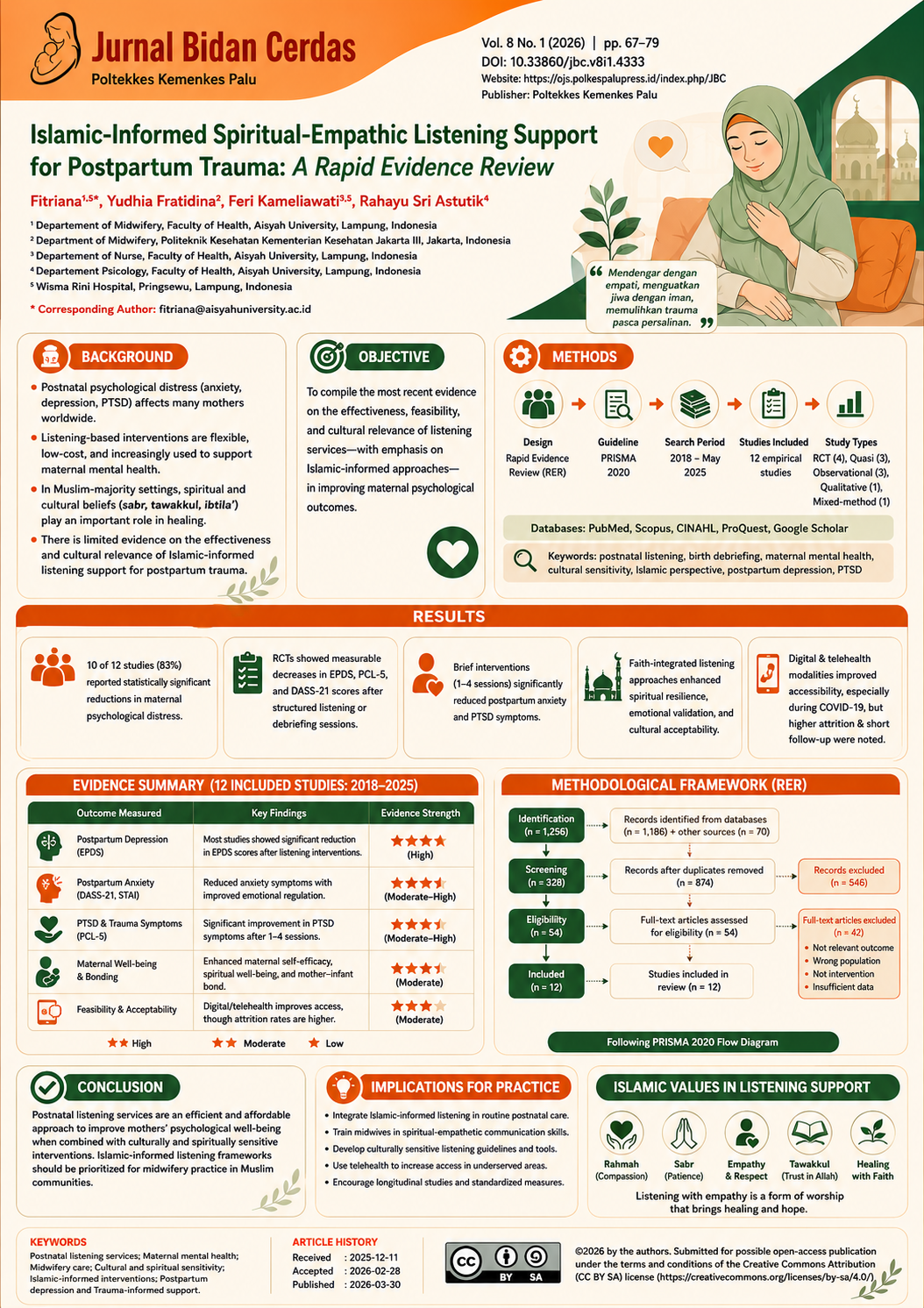
Islamic-Informed Spiritual-Empathic Listening Support for Postpartum Trauma: A Rapid Evidence Review

https://doi.org/10.33860/jbc.v8i1.4333
Keywords:
Postnatal listening services, Maternal mental health, Midwifery care, Cultural and spiritual sensitivity, Islamic-informed interventions, Postpartum depression and Trauma-informed supportAbstract
Background: A worldwide health concern is postnatal psychological discomfort, which includes symptoms of anxiety, and despair. Although listening-based therapies have become popular as flexible, low-cost ways to treat maternal mental health, there is currently little data on their efficacy and cultural fit. With an emphasis on Islamic-informed approaches, this study sought to compile the most recent data on the efficacy, viability, and cultural significance of listening services in enhancing maternal psychological outcomes.
Methods: A Rapid Evidence Review (RER) was conducted following PRISMA 2020 guidelines. Twelve empirical studies published between 2018 and May 2025 were included (4 randomized controlled trials, 3 quasi-experimental studies, 3 observational studies, 1 qualitative, and 1 mixed-method design).
Results: Ten of the twelve studies (83%) reported statistically significant reductions in maternal psychological distress. Randomized controlled trials demonstrated measurable decreases in EPDS, PCL-5, and DASS-21 scores following structured midwife-led debriefing or counseling sessions. Several interventions showed significant reductions in postpartum anxiety and PTSD symptoms after brief (1–4 session) models. Faith-integrated listening approaches in Muslim-majority settings enhanced spiritual resilience, emotional validation, and cultural acceptability. Digital and telehealth modalities improved accessibility, particularly during the COVID-19 pandemic, although higher attrition rates and short follow-up durations were frequently noted.
Conclusion: Postnatal listening services are an efficient and affordable way to improve the psychological well-being of mothers when paired with treatment that is sensitive to cultural and spiritual differences. Future studies and clinical applications should place a high priority on formalizing Islamic informed listening frameworks in midwifery practice in Muslim communities.
Downloads
References
Á, M. M.-, Manuel, J., Mimun-navarro, K., & Pozo-muñoz, C. (2023). Muslim and Christian Women ’ s Perceptions of the Influence of Spirituality and Religious Beliefs on Motherhood and Child-Rearing : A Phenomenological Study. Healthcare (Basel, Switzerland), 11(22), 2932. https://doi.org/10.3390/healthcare11222932
Abhari, Z. H., Karimi, F. Z., & Mazloom, S. R. (2020). Effect of Counseling Based on Gamble ’ s Approach on Postpartum Anxiety in Primiparous Women. J Midwifery Reprod Health. 2021; 9(1):2530-2540, 5, 1–11. https://doi.org/10.22038/jmrh.2019.44596.1535
Ali, F., Bouzoubaa, K., Gelli, F., & Hamzi, B. (2025). Islamic Ethics and AI : An Evaluation of Existing Approaches to AI using Trusteeship Ethics. Philosophy & Technology, 120(38). https://doi.org/10.1007/s13347-025-00922-4
Aston, M., Price, S., Macleod, A., Stone, K., Benoit, B., Joy, P., Ollivier, R., Sim, M., Etowa, J., Jack, S., Marcellus, L., & Iduye, D. (2024). Examining How Postpartum Videoconferencing Support Sessions Can Facilitate Connections between Parents : A Poststructural and Sociomaterial Analysis. 99–114. https://doi.org/10.3390/nursrep14010009
Baker, H., Cuomo, B., Femia, C., Mclean, B., Hatfield, M., Lin, D., & Stobbie, C. (2024). Occupational therapy in maternal health : Exploring the Barkin Index of Maternal Functioning as a potential tool. August 2023, 279–290. https://doi.org/10.1111/1440-1630.12926
Bannister, L., Hammond, A., Dahlen, H. G., & Keedle, H. (2025). A content analysis of women ’ s experiences of debriefing following childbirth : The birth experience study ( BESt ). Midwifery, 146(September 2024), 104421. https://doi.org/10.1016/j.midw.2025.104421
Bentley, J. A., Feeny, N. C., Dolezal, M. L., Klein, A., Marks, L. H., Graham, B., & Zoellner, L. A. (2022). Islamic Trauma Healing: Integrating Faith and Empirically Supported Principles in a Community-Based Program. 28(2), 167–192. https://doi.org/10.1016/j.cbpra.2020.10.005.Islamic
Bolton, P., West, J., Whitney, C., Jordans, M. J. D., Thornicroft, G., Murray, L., Snider, L., Eaton, J., Collins, P. Y., & Ventevogel, P. (2023). Expanding mental health services in low- and middle-income countries : A task-shifting framework for delivery of comprehensive , collaborative , and community-based care. https://doi.org/10.1017/gmh.2023.5
Damani, K. (2020). Accelerated Learning and EdTech: A Rapid Evidence Review. https://doi.org/10.5281/zenodo.DOI%2010.5281/zenodo.4556941
Garapati, J., Jajoo, S., Aradhya, D., Reddy, L. S., Dahiphale, S. M., & Patel, D. J. (2023). Postpartum Mood Disorders : Insights Into Diagnosis , Prevention , and Treatment. 15(7). https://doi.org/10.7759/cureus.42107
Gauci, J., & Parascandalo, R. P. (2025). The lived experiences of newly qualified midwives in supporting women during labor and birth : A hermeneutic phenomenological study in Malta. 42(5), 1–11. https://doi.org/10.18332/ejm/200073
Hanach, N., Radwan, H., Bani, W., Saqan, R., & Vries, N. De. (2024). The perceived mental health experiences and needs of postpartum mothers living in the United Arab Emirates : A focus group study. Midwifery, 132(September 2023), 103977. https://doi.org/10.1016/j.midw.2024.103977
Hassan, S. M. (2022). Religious practices of Muslim women in the UK during maternity : evidence ‑ based professional practice recommendations. BMC Pregnancy and Childbirth, 1–17. https://doi.org/10.1186/s12884-022-04664-5
Horsch, A., Garthus-niegel, S., Ayers, S., & Chandra, P. (2024). Expert Review Childbirth-related posttraumatic stress disorder : The American Journal of Obstetrics & Gynecology, 230(3), S1116–S1127. https://doi.org/10.1016/j.ajog.2023.09.089
Institutional, L. (2023). British Muslims ’ experiences of pregnancy and birth. https://openaccess.city.ac.uk/id/eprint/29686
LEARMAN, L. E. E. A. (2018). Screening for Depression in Pregnancy and the Postpartum Period. Clinical Obstetrics and Gynecology, 61(3). https://doi.org/10.1097/grf.0000000000000359
Mousavi, S., Nourizadeh, R., Babapour, J., & Hakimi, S. (2024). Investigating the Effect of Debriefing Intervention on Postpartum Posttraumatic Stress Disorder. 12(1), 42–47. https://doi.org/10.15296/ijwhr.2023.29
Nasrin, M. I. (2025). The Influence of Islamic Spiritual Values on Students ’ Mental Health : A Special Focus on Tawakkul ( ل ُّ كوت ), Sabr ( ربص ) and Shukr ( ركش ). 4(2), 260–272. https://doi.org/10.58355/lectures.v4i2.150
Nurbaeti, I. (2023). Association between Islamic religiosity , social support , marriage satisfaction , and postpartum depression in teenage mothers in West Java , Indonesia : A cross-sectional study. 9(4), 313–321. https://doi.org/10.33546/bnj.2661
Omar, A., Saansong, A., Adoma, P. O., Nkrumah, J., & Gbagbo, F. Y. (2024). Experience and perceived impact of anxiety and depression on quality of life following emergency caesarean section among women in Ghana : a qualitative study. 1–11. https://doi.org/10.1136/bmjopen-2024-086069
Page, M. J., Mckenzie, J. E., Bossuyt, P. M., Boutron, I., Hoffmann, C., Mulrow, C. D., Shamseer, L., Tetzlaff, J. M., Akl, E. A., Brennan, S. E., Chou, R., Glanville, J., Grimshaw, J. M., Hróbjartsson, A., Lalu, M. M., Li, T., Loder, E. W., Mayo-wilson, E., Mcdonald, S., … Moher, D. (2021). The PRISMA 2020 statement : an updated guideline for reporting systematic reviews Systematic reviews and Meta-Analyses. https://doi.org/10.1136/bmj.n71
Rezeck Nunes, P., Gustavo de Oliveira, L., Romão Veiga, M., & Terezinha Serrão Peraçoli, M. (2019). Autophagy in Preeclampsia. Prediction of Maternal and Fetal Syndrome of Preeclampsia, 1–16. https://doi.org/10.5772/intechopen.85592
Sakineh, N., Sepideh, H., Zohreh, A., & Hamid, A. M. (2022). Effect of Participatory Care Model on Postpartum Quality of Life and Performance During the COVID-19 Pandemic 1. 37(3), 14–15. https://doi.org/10.5001/omj.2022.68
Schobinger, E., Stuijfzand, S., & Horsch, A. (2020). Acute and Post-traumatic Stress Disorder Symptoms in Mothers and Fathers Following Childbirth : A Prospective Cohort Study. 11(December), 1–11. https://doi.org/10.3389/fpsyt.2020.562054
Small, R., Lumley, J., Donohue, L., Potter, A., & Waldenström, U. (2000). Randomised controlled trial of midwife led debriefing to reduce maternal depression after operative childbirth. BMJ (Clinical Research Ed.), 321(7268), 1043–1047. https://doi.org/10.1136/bmj.321.7268.1043
Sun, X., Fan, X., Cong, S., & Wang, R. (2023). Psychological birth trauma : A concept analysis. January, 1–14. https://doi.org/10.3389/fpsyg.2022.1065612
Tavares, D., Fidalgo, D., Sousa, M., Morais, A., Lamela, D., Alves, S., Costa, R., & Miguel, T. (2025). History of mental health problems moderates the association between partner support during childbirth and women ’ s mental health in the postpartum period. 144(February). https://doi.org/10.1016/j.midw.2025.104359
Thomson, G., & Nowland, R. (2024). A rapid evidence review of postnatal listening services for women following a traumatic or negative childbirth experience. Midwifery, 139(May), 104185. https://doi.org/10.1016/j.midw.2024.104185
Trinko, V., Sarewitz, J., & Athan, A. (2025). Improving maternal well ‑ being : a matrescence education pilot study for new mothers. Maternal Health, Neonatology and Perinatology, 0. https://doi.org/10.1186/s40748-025-00203-0
Vega-esca, J. (2022). The efficacy of religious and spiritual interventions in nursing care to promote mental , physical and spiritual health : A systematic review and. 67(January). https://doi.org/10.1016/j.apnr.2022.151618
Downloads
Published
How to Cite
Issue
Section
License
Copyright (c) 2026 Fitriana, Yudhia Fratidina, Feri Kameliawati, Rahayu Sri Astutik (Author)

This work is licensed under a Creative Commons Attribution-ShareAlike 4.0 International License.
Authors who publish with Jurnal Bidan Cerdas agree to the following terms:
- Authors retain copyright and grant the journal right of first publication with the work simultaneously licensed under a Creative Commons Attribution License (CC BY-SA 4.0) that allows others to share the work with an acknowledgment of the work's authorship and initial publication in this journal.
- Authors are able to enter into separate, additional contractual arrangements for the non-exclusive distribution of the journal's published version of the work (e.g., post it to an institutional repository or publish it in a book), with an acknowledgment of its initial publication in this journal.
- Authors are permitted and encouraged to post their work online (e.g., in institutional repositories or on their website) prior to and during the submission process, as it can lead to productive exchanges, as well as earlier and greater citation of published work.

This work is licensed under a Creative Commons Attribution-Share Alike 4.0 International License
You are free to:
- Share, copy and redistribute the material in any medium or format
- Adapt, remix, transform, and build upon the material for any purpose, even commercially.
- The licensor cannot revoke these freedoms as long as you follow the license terms.