Effects of Reflexology Therapy Implementation for Postpartum Mothers’ Well-being at a Health Care Facility

https://doi.org/10.33860/jbc.v8i1.4326
Keywords:
Non-pharmacological intervention, Pain modulation, Psychological stress, Maternal satisfaction, Holistic midwifery careAbstract
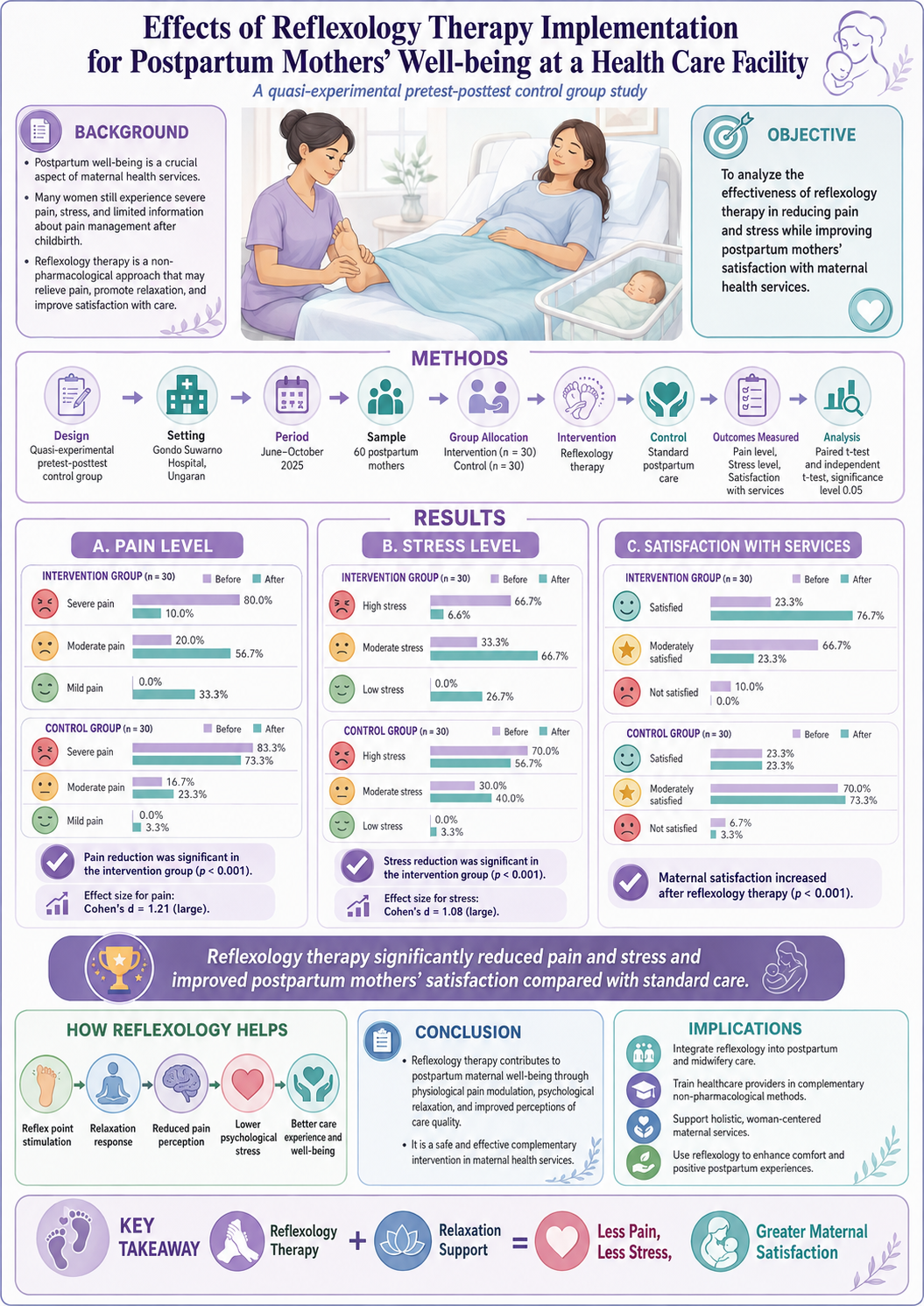
Background: The well-being of postpartum mothers is a crucial aspect of maternal health services. However, many women encounter challenges during childbirth, including severe pain, stress, and a lack of information on pain management. Data from the Association of Indonesian Hospitals show that 15% of postpartum mothers experience complications, 21% suffer from severe pain, and 64% do not receive information on how to reduce labor pain. Reflexology therapy serves as a non-pharmacological method to relieve pain and enhance relaxation. This study analyzed the effectiveness of reflexology therapy in reducing pain and stress while improving the satisfaction of postpartum mothers with maternal health services.
Methods: The study used a quasi-experimental design with a pretest–posttest control group, conducted from June to October 2025 at Gondo Suwarno Hospital, Ungaran. Researchers purposively selected 60 postpartum mothers and divided them into two groups: an intervention group and a control group. Data were analyzed using paired t-tests and independent t-tests with a significance level of 0.05.
Results: Reflexology therapy significantly reduced pain and stress scores and increased maternal satisfaction in the intervention group, while no significant changes were observed in the control group. Between-group comparisons confirmed that the magnitude and direction of outcome changes favored the intervention group (p < 0.05). Reflexology therapy significantly reduced pain and stress levels in the intervention group compared to the control group (p < 0.05) and increased satisfaction with health services.
Conclusion: Reflexology therapy contributes to postpartum maternal well-being through physiological pain modulation, psychological relaxation, and improved perceptions of care quality. Healthcare providers are encouraged to integrate reflexology as a complementary intervention in maternal health services.
Downloads
References
Aghaei, A., Hosseini, S., & Rahmanian, R. (2025). The effectiveness of reflexology and yoga interventions on pain and stress reduction during childbirth: A meta-analysis. Journal of Maternal Health Research, 18(2), 45–56. https://doi.org/10.1016/j.jmhr.2025.02.006
Ahmed, S., Rahman, M., & Kim, H. J. (2024). Global burden of maternal well-being: An integrative review of psychosocial stress and perinatal outcomes. Global Health Science Review. Global Health Science Review, 12(1), 22–34. https://doi.org/10.1177/ghsr2024-012
Astuti, E., & Rahayu, D. (2024). Holistic approaches in midwifery care to improve the maternal birth experience. Indonesian Journal of Midwifery and Reproductive Health, 8(1), 78–87. https://doi.org/10.31004/ijmrh.2024.812
Bouya, S., Rezaie Keikhaie, L., Hosseini, S. S., & Rezaie Keikhaie, K. (2020). The effect of yoga on uterine artery Doppler indices, maternal and fetal complications in pregnant women: A quasi-experimental study. Journal of Ayurveda and Integrative Medicine, 11(4), 4–8. https://doi.org/10.1016/j.jaim.2020.07.00
Capili, B., & Anastasi, J. K. (2024). An Introduction to the Quasi-Experimental Design (Nonrandomized Design). The American Journal of Nursing, 124(11), 50. https://doi.org/10.1097/01.NAJ.0001081740.74815.20
Dagli, F., Yildirim, N., & Koc, G. (2024). The combined effects of reflexology and hypnolactation techniques on maternal stress and positive childbirth perception: A randomized controlled trial. Journal of Maternal and Child Health Research, 22(1), 34–42. https://doi.org/10.1016/j.jmch.2024.01.005
Field, T. (2024). Massage and reflexology in labor pain management: A theoretical update on gate control mechanisms. Journal of Complementary Therapies, 39(3), 250–259. https://doi.org/10.1016/j.ctcp.2024.03.010
Fransisca, D., & Yusuf, R. N. (2019). Hubungan senam nifas dengan involusi uterus pada ibu nifas. Jurnal Kesehatan Medika Saintika, 10(2), 45–50. https://doi.org/10.30633/jkms.v10i2.332
Ghaffari, F., Sadeghi, M., & Karimi, R. (2024). Physiological and hormonal responses to reflexology during pregnancy and labor: A randomized controlled trial. Complementary Medicine in Women’s Health, 6(2), 110–118. https://doi.org/10.1016/j.cmw.2024.06.009
Health, Indonesian. Ministry of. (2021). National maternal health report. Jakarta. https://kemkes.go.id
Idhayanti, R. I., Warastuti, A., & Yuniyanti, B. (2020). Mobilisasi dini menurunkan nyeri akibat jahitan perineum tingkat II pada ibu postpartum. Jurnal Jendela Inovasi Daerah, 3(1), 22–29.
http://jurnal.magelangkota.go.id/index.php/cendelainovasi/article/view/85
Kementrian Kesehatan Republik Indonesia. (2023). Laporan nasional kesehatan ibu dan anak. Jakarta. https://repository.badankebijakan.kemkes.go.id/id/eprint/5537/
Khotimah, N., & Putri, A. S. (2024). Determinants of maternal satisfaction with delivery services in primary healthcare facilities in Indonesia. Journal of Midwifery Studies, 10(1), 15–25. https://doi.org/10.52145/jms.2024.10102
Kusfaningrum, H., Rejeki, R., & Astuti, T. (2023). Efektivitas intervensi nonfarmakologis terhadap penurunan nyeri persalinan: Kajian sistematis literatur di Indonesia. Jurnal Kebidanan Dan Kesehatan Reproduksi, 15(3), 210–222. https://doi.org/10.26714/jkkr.15.3.2023.210-222
Leki, Y., & Ti’ani, P. (2024). A combination of ball exercise and finger reflexology to reduce labor pain during the active phase among primiparous mothers. Midwifery Clinical Practice Journal, 5(2), 89–97. https://doi.org/10.20473/mcpj.v5i2.2024.89
Martin Nguyen, A., Bacci, E. D., Vernon, M., Birring, S. S., Rosa, C. La, Muccino, D., & Schelfhout, J. (2021). Validation of a visual analog scale for assessing cough severity in patients with chronic cough. Therapeutic Advances in Respiratory Disease, 15. https://doi.org/10.1177/17534666211049743
Nasution, L., Harahap, D. I., & Lubis, N. M. (2025). Efektivitas terapi refleksi terhadap kenyamanan dan relaksasi ibu bersalin di rumah sakit rujukan di Indonesia. Jurnal Kebidanan Dan Kesehatan Reproduksi, 18(1), 55–64. https://doi.org/10.26714/jkkr.18.1.2025.55-64
Pasiriani, N., & Juniawati, D. (2023). Manajemen nyeri persalinan: Evaluasi intervensi nonfarmakologis terhadap kesejahteraan ibu di ruang bersalin. Jurnal Ilmu Kebidanan Dan Kesehatan, 15(3), 201–210. https://doi.org/10.33846/jikk.v15i3.2023.201
Pedersen, H. S., Christensen, K. S., Prior, A., & Christensen, K. B. (2024). The dimensionality of the Perceived Stress Scale: The presence of opposing items is a source of measurement error. Journal of Affective Disorders, 344, 485–494. https://doi.org/10.1016/j.jad.2023.10.109
Putri, A. D., Hanifah, N., & Irawan, F. (2023). Maternal well-being during childbirth: A global perspective on quality maternal care. International Journal of Women’s Health and Midwifery, 17(2), 99–108. https://doi.org/10.1016/j.ijwhm.2023.99
Rahmah, N., Wardani, D., & Yuliana, S. (2024). Validation of the Perceived Stress Scale (PSS-10) among Indonesian postpartum mothers: Psychometric evaluation. Indonesian Journal of Nursing and Health Science, 12(4), 301–310. https://doi.org/10.11591/ijnhs.v12i4.2024
Silva, M. R., Barreto, R. S., & Mendes, L. F. (2024). Maternal well-being and birth satisfaction: A cross-sectional study in Brazil. BMC Pregnancy and Childbirth, 24(112), 1–9. https://doi.org/10.1186/s12884-024-0112
Smith, C. A., Levett, K. M., Collins, C. T., & Dahlen, H. G. (2019). Complementary and alternative therapies for labor pain: A systematic review. Journal of Obstetric, Gynecologic & Neonatal Nursing, 48(4), 398–409. https://doi.org/10.1016/j.jogn.2019.02.007
Suryani, E., & Pramudito. (2024). Hubungan tingkat nyeri dan kadar kortisol dengan lama persalinan pada ibu bersalin di rumah sakit rujukan. Jurnal Ilmu Kesehatan Indonesia, 9(2), 98–107. https://doi.org/10.31219/jiki.v9i2.2024
Wang, C., Lee, H., & Zhao, L. (2024). Reflexology in obstetric care: Physiological mechanisms and outcomes in labor pain reduction. Women’s Health International, 30(1), 50–61. https://doi.org/10.1080/whi.2024.3030
WHO. (2025). Maternal and newborn health: Improving quality of care for a positive childbirth experience. Retrieved from https://www.who.int/publications/maternal-health-2025
Wulandari, A., Setiawan, H., & Yani, R. (2024). Psychological determinants of maternal well-being during childbirth in Indonesia: The role of social support and self-efficacy. Journal of Health Behavior Research, 11(1), 41–53. https://doi.org/10.11591/jhbr.v11i1.2024
Downloads
Published
How to Cite
Issue
Section
License
Copyright (c) 2026 Mudy Oktiningrum, Tia Nurhanifah, Mianti Nurizky (Author)

This work is licensed under a Creative Commons Attribution-ShareAlike 4.0 International License.
Authors who publish with Jurnal Bidan Cerdas agree to the following terms:
- Authors retain copyright and grant the journal right of first publication with the work simultaneously licensed under a Creative Commons Attribution License (CC BY-SA 4.0) that allows others to share the work with an acknowledgment of the work's authorship and initial publication in this journal.
- Authors are able to enter into separate, additional contractual arrangements for the non-exclusive distribution of the journal's published version of the work (e.g., post it to an institutional repository or publish it in a book), with an acknowledgment of its initial publication in this journal.
- Authors are permitted and encouraged to post their work online (e.g., in institutional repositories or on their website) prior to and during the submission process, as it can lead to productive exchanges, as well as earlier and greater citation of published work.

This work is licensed under a Creative Commons Attribution-Share Alike 4.0 International License
You are free to:
- Share, copy and redistribute the material in any medium or format
- Adapt, remix, transform, and build upon the material for any purpose, even commercially.
- The licensor cannot revoke these freedoms as long as you follow the license terms.