Exclusive Breastfeeding and Complementary Feeding Practices Are Associated with Stunting among Children Aged 6–24 Months: A Cross-Sectional Study in Sigi Regency

https://doi.org/10.33860/jbc.v8i1.4315
Keywords:
Stunting, Exclusive Breastfeeding, Complementary FoodsAbstract
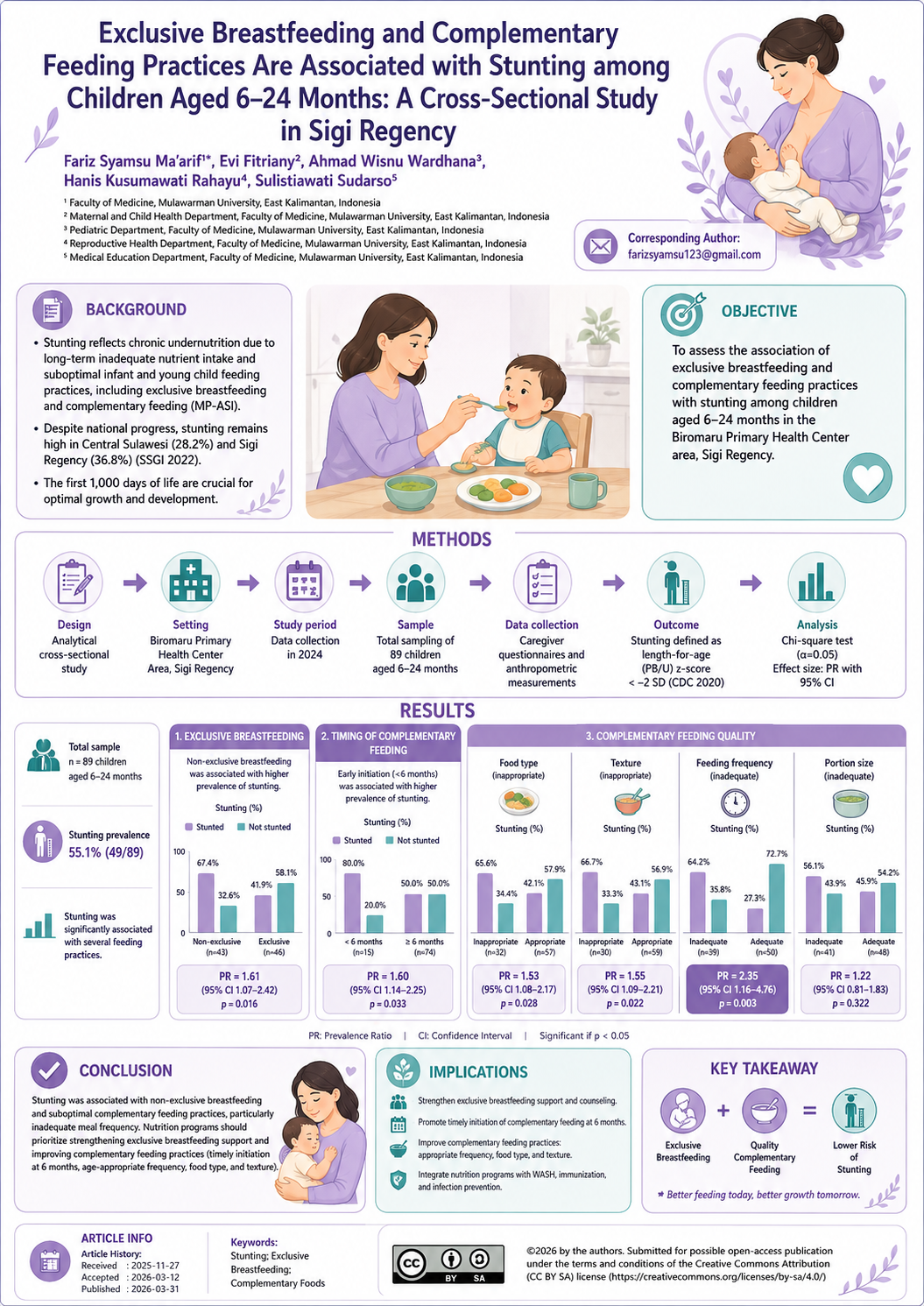
Background: Stunting is a chronic nutrition problem associated with long-term inadequate nutrient intake and suboptimal infant and young child feeding practices, including exclusive breastfeeding and complementary feeding (MP-ASI). This study assessed the association of exclusive breastfeeding and complementary feeding practices with stunting among children aged 6–24 months in the Biromaru Primary Health Center area, Sigi Regency. Methods: This analytical cross-sectional study included 89 children aged 6–24 months selected using total sampling. Data were collected through caregiver questionnaires and anthropometric measurements. Stunting was defined as length-for-age (PB/U) z-score < −2 SD based on the CDC 2020 reference. Associations were tested using the chi-square test (α=0.05), and effect sizes are presented as prevalence ratios (PR) with 95% confidence intervals (CI). Results: The prevalence of stunting was 55.1% (49/89). Stunting was significantly associated with non-exclusive breastfeeding (67.4% vs 41.9%; PR=1.61, 95% CI 1.07–2.42; p=0.016) and early initiation of complementary feeding <6 months (80.0% vs 50.0%; PR=1.60, 95% CI 1.14–2.25; p=0.033). Among complementary feeding quality indicators, inappropriate food type (PR=1.53, 95% CI 1.08–2.17; p=0.028), texture (PR=1.55, 95% CI 1.09–2.21; p=0.022), and especially feeding frequency (64.2% vs 27.3%; PR=2.35, 95% CI 1.16–4.76; p=0.003) were associated with stunting. Portion size was not significantly associated with stunting (PR=1.22, 95% CI 0.81–1.83; p=0.322). Conclusion: In this setting, stunting was associated with non-exclusive breastfeeding and suboptimal complementary feeding practices, particularly inadequate meal frequency. Nutrition programs should prioritize strengthening exclusive breastfeeding support and improving complementary feeding practices (timely initiation at 6 months, age-appropriate frequency, food type, and texture).
Downloads
References
Abdullah, I. N. M., Alfaaizin, L., & Jamal, R. S. (2024). Hubungan Pemberian MP-ASI Oleh Ibu dengan Kejadian Stunting pada Balita di Desa Bontokassi Kecamatan Galesong Selatan Kabupaten Takalar Tahun 2023. Jurnal Riset Kesehatan Terapan, 06(01), 13–23. https://jurnal.poltekkespalupress.id/index.php/JRKT
Damayanti, R. A., Muniroh, L., & Farapti, F. (2017). Perbedaan Tingkat Kecukupan Zat Gizi Dan Riwayat Pemberian Asi Eksklusif Pada Balita Stunting Dan Non Stunting. Media Gizi Indonesia, 11(1), 61. https://doi.org/10.20473/mgi.v11i1.61-69
Grasela, I. A., Srikandi Syahadat, D., Radiah, S., Fadhilah Sari, N., Mantao, E., Sanjaya, K., & Krisnasari, S. (2023). Faktor Yang Berhubungan Dengan Kejadian Stunting Anak Usia 0-24 Bulan Di Wilayah Kerja Puskesmas Biromaru Kabupaten Sigi. Jurnal Kesehatan Tambusai, 4(2),2432–2441. https://journal.universitaspahlawan.ac.id/index.php/jkt/article/view/15193
Kemenkes RI. (2022). Hasil Survei Status Gizi Indonesia (SSGI) 2022. Kemenkes, 1–150. https://ayosehat.kemkes.go.id/pub/files/files46531._MATERI_KABKPK_SOS_SSGI.pdf
Kemenkes RI. (2023). Buku Resep Makanan Lokal. https://gizi.kemkes.go.id
Kemenkes RI. (2025). SSGI 2024 : Prevalensi Stunting Nasional Turun Menjadi 19,8%. Kemenkes RI. https://kemkes.go.id/id/ssgi-2024-prevalensi-stunting-nasional-turun-menjadi-198
Latifah, A. M., Purwanti, L. E., & Sukamto, F. I. (2020). Hubungan Pemberian Asi Eksklusif dengan Kejadian Stunting pada Balita 1-5 Tahun. Health Sciences Journal, 4(1), 142. https://doi.org/10.24269/hsj.v4i1.409
Louis, S. L., Mirania, A. N., & Yuniarti, E. (2022). Hubungan Pemberian ASI Eksklusif dengan Kejadian Stunting pada Anak Balita. Maternal & Neonatal Health Journal, 3(1), 7–11. https://doi.org/10.37010/mnhj.v3i1.498
Maesarah, M., Adam, D., Hatta, H., Djafar, L., & Ka’aba, I. (2021). Hubungan Pola Makan dan Riwayat ASI Ekslusif Dengan Kejadian Stunting Pada Balita di Kabupaten Gorontalo. Al Gizzai: Public Health Nutrition Journal, 1(1), 50–58. https://doi.org/10.24252/algizzai.v1i1.19082
Maharani S. Hubungan Praktik Pemberian MPASI terhadap Kejadian Stunting pada Baduta Usia 6–23 Bulan di Wilayah Kerja Puskesmas Bontokassi Kabupaten Takalar [skripsi]. Makassar: Universitas Muhammadiyah Makassar; 2022.
Maryanto, S. (2020). the Correlation Between Complementary Feeding and First Complementary Feeding Time With Stunting in Children of 6-24. Researchgate.Net, 12(27), 29–39. https://www.researchgate.net
Nurkomala, S., Nuryanto, N., & Panunggal, B. (2018). Praktik Pemberian Mpasi (Makanan Pendamping Air Susu Ibu) Pada Anak Stunting Dan Tidak Stunting Usia 6-24 Bulan. Journal of Nutrition College, 7(2), 45. https://doi.org/10.14710/jnc.v7i2.20822
Nurmalisa, B. E. (2022). Hubungan Pengetahuan Ibu tentang Asi Eksklusif dan Pemberian MPASI dengan Kejadian Stunting pada Anak Usia 24-59 Bulan di Desa Bale Wilayah Kerja Puskesmas Wani Kecamatan Donggala. Lentora Nursing Journal, 2, 83–94. https://www.researchgate.net/publication/377122571_Relationship_between_Mother’s_Knowledge_about_Exclusive_Breastfeeding_and_Giving_MPASI_with_Stunting_Incidence_in_Children_Aged_24-
Putri, E. N. (2019). Hubungan Antara Pemberian Asi Dengan Derajat Stunting Pada Bayi Usia 6-12 Bulan Di Wilayah Kerja Puskesmas Kenjeran Surabaya. Skripsi, STIKes Hang Tuah Surabaya. https://repository.stikeshangtuah-sby.ac.id
Rahayu, A., Yulidasari, F., Putri, A. O., & Anggraini, L. (2018). Stunting dan Upaya Pencegahannya. In Buku stunting dan upaya pencegahannya. http://kesmas.ulm.ac.id/id/buku-stunting-dan-upaya-pencegahannya/
Saputra, R., Sanjaya, R. A., Maina, A. D., Ulyah, R. T., Fikriah, I., Khotimah, S., Bakhtiar, R., Sudarso, S., & Sawitri, E. (2023). Intervensi Pencegahan Stunting pada Anak di Kutai Kartanegara dan Samarinda. Kumawula: Jurnal Pengabdian Kepada Masyarakat, 6(2), 254. https://doi.org/10.24198/kumawula.v6i2.42526
Shakeela, K. (2022). Hubungan Pemberian Asi Eksklusif Dan Pola Mpasi Dengan Kejadian Stunting Pada Anak Usia 12-24 Bulan Di Pandeglang, Banten. Cerdika: Jurnal Ilmiah Indonesia, 2(11), 992–1007. https://doi.org/10.36418/cerdika.v2i11.474
Sudirman, N. A. (2022). Hubungan ASI Eksklusif dan MPASI dengan Kejadian Stunting pada Balita 6-24 Bulan. [skripsi]. Makassar: Universitas Muhammadiyah Makassar; 2022.
Sudirman, N. A., Utami Murti Pratiwi, Andi Irhamnia Sakinah, & Purnamaniswaty Yunus. (2024). Hubungan ASI Eksklusif dengan Kejadian Stunting pada Balita 6-24 Bulan. Alami Journal (Alauddin Islamic Medical) Journal, 8(1), 1–7. https://doi.org/10.24252/alami.v8i1.35655
Suyadi ES. Kejadian KEP Balita dan Faktor yang Berhubungan di Wilayah Kelurahan Pancoran Mas Depok Tahun 2009 [Skripsi]. Depok: Fakultas Kesehatan Masyarakat, Universitas Indonesia; 2009
UNICEF. (2021). Levels and trends in child malnutrition UNICEF / WHO / World Bank Group Joint Child Malnutrition Estimates Key findings of the 2021 edition. World Health Organization, 1–32. https://data.unicef.org/resources/jme-report-2021/
Wangiyana, N. K. A. S., Karuniawaty, T. P., John, R. E., Qurani, R. M., Tengkawan, J., Septisari, A. A., & Ihyauddin, Z. (2021). The Complementary Feeding Practice And Risk Of Stunting Among Children Aged 6-12 Months In Central Lombok. Penelitian Gizi Dan Makanan (The Journal of Nutrition and Food Research), 43(2), 81–88. https://doi.org/10.22435/pgm.v43i2.4118
Wardita, Y., Suprayitno, E., & Kurniyati, E. M. (2021). Determinan Kejadian Stunting pada Balita. Journal Of Health Science (Jurnal Ilmu Kesehatan), 6(1), 7–12. https://doi.org/10.24929/jik.v6i1.1347
WHO. (2014). Global nutrition targets 2025: stuntig policy brief. 122(2), 74–76, 78. https://www.who.int/publications/i/item/WHO-NMH-NHD-14.3
Widyawati, W., Febry, F., & Destriatania, S. (2016). Analysis Complementary Feeding And Nutritional Status Among Children Aged 12-24 Months In Puskesmas Lesung Batu, Empat Lawang. Jurnal Ilmu Kesehatan Masyarakat, 7(2), 139–149. https://doi.org/10.26553/jikm.2016.7.2.139-149
Yuningsih, Y., & Perbawati, D. (2022). Hubungan Jenis Kelamin terhadap Kejadian Stunting. Jurnal MID-Z (Midwivery Zigot) Jurnal Ilmiah Kebidanan, 5(1), 48–53. https://doi.org/10.56013/jurnalmidz.v5i1.1365
Downloads
Published
How to Cite
Issue
Section
License
Copyright (c) 2026 Fariz Syamsu Ma’arif, Evi Fitriany, Ahmad Wisnu Wardhana, Hanis Kusumawati Rahayu, Sulistiawati Sudarso (Author)

This work is licensed under a Creative Commons Attribution-ShareAlike 4.0 International License.
Authors who publish with Jurnal Bidan Cerdas agree to the following terms:
- Authors retain copyright and grant the journal right of first publication with the work simultaneously licensed under a Creative Commons Attribution License (CC BY-SA 4.0) that allows others to share the work with an acknowledgment of the work's authorship and initial publication in this journal.
- Authors are able to enter into separate, additional contractual arrangements for the non-exclusive distribution of the journal's published version of the work (e.g., post it to an institutional repository or publish it in a book), with an acknowledgment of its initial publication in this journal.
- Authors are permitted and encouraged to post their work online (e.g., in institutional repositories or on their website) prior to and during the submission process, as it can lead to productive exchanges, as well as earlier and greater citation of published work.

This work is licensed under a Creative Commons Attribution-Share Alike 4.0 International License
You are free to:
- Share, copy and redistribute the material in any medium or format
- Adapt, remix, transform, and build upon the material for any purpose, even commercially.
- The licensor cannot revoke these freedoms as long as you follow the license terms.