The Effect of Lavender Aromatherapy Scores in Mothers with Postpartum Blues

https://doi.org/10.33860/jbc.v8i1.4291
Keywords:
Edinburgh Postnatal Depression Scale, Lavender, Aromatherapy, postpartum bluesAbstract
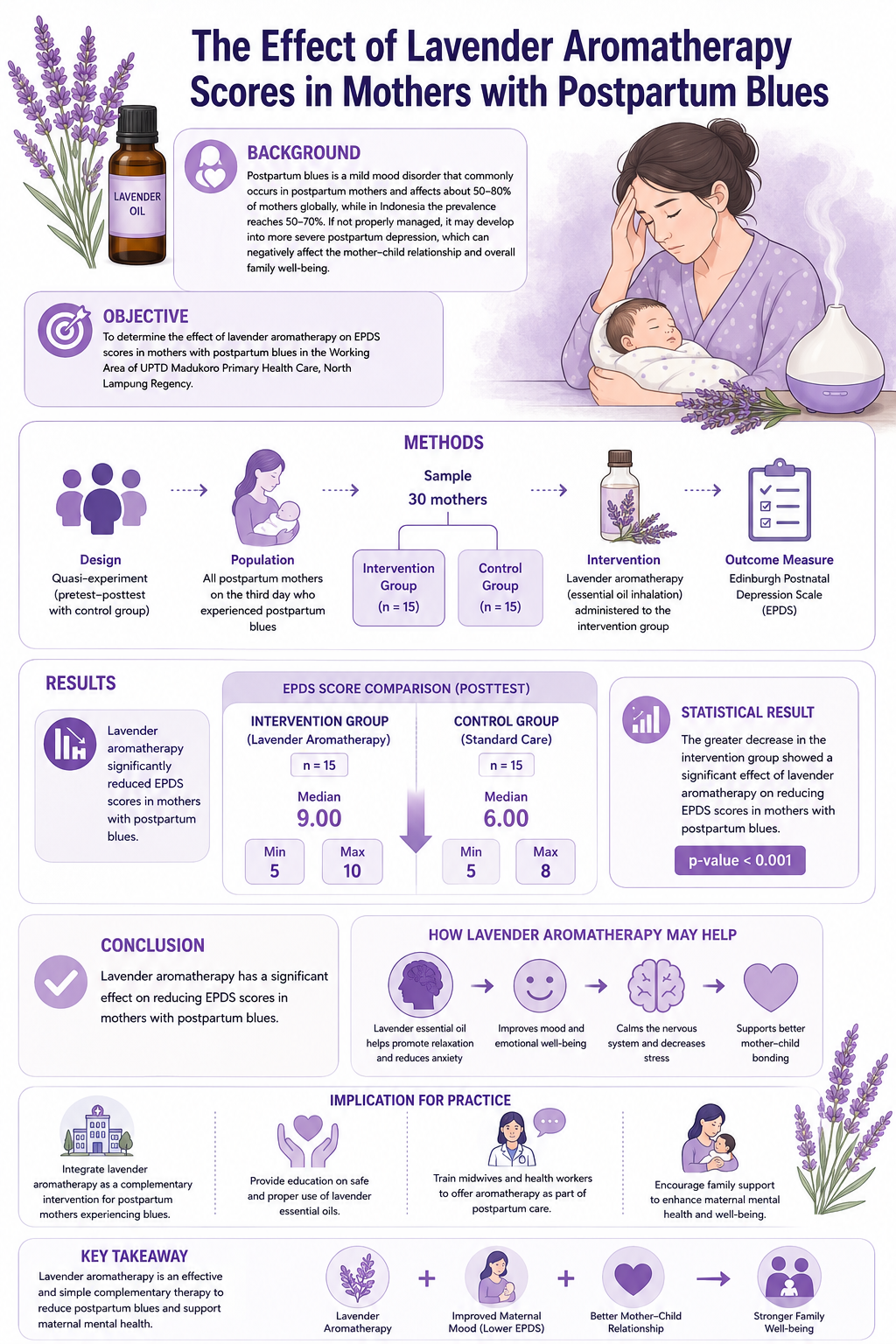
Introduction: Postpartum blues is a mild mood disorder that commonly occurs in postpartum mothers, characterized by mood swings, anxiety, and emotional exhaustion. Globally, the incidence of postpartum blues is affects about 50-80% of mothers after giving birth, while in Indonesia the prevalence reaches 50-70%, If not properly managed, this condition may develop into more severe postpartum depression, which can negatively affect the mother–child relationship and overall family well-being. This study aims to determine the effect of lavender aromatherapy on EPDS scores in mothers with postpartum blues in the Working Area of UPTD Madukoro Primary Health Care, North Lampung Regency
Methods: This study used quantitative methods with a quasi experiment design and pretest-posttest design with control group. The study population consisted of all postpartum mothers on the third day who experienced postpartum blues, with a sample of 30 participants divided into 15 in the intervention group and 15 in the control group.
Results: The results showed that the average EPDS score in the group given lavender aromatherapy decreased from 11.87 to 3.6. In the control group, it decreased from 11.53 to 5.27. The greater decrease in the intervention group showed a significant effect of lavender aromatherapy on reducing EPDS scores in mothers with postpartum blues with a p-value of 0.000.
Conclusion: lavender aromatherapy has a significant effect on reducing EPDS scores in mothers with postpartum blues.
Downloads
References
Amin, E., Rahardjo, B., & Kusworini. (2021). Aromaterapi lavender menurunkan skor edinburgh postpartum depression scala pada ibu dengan postpartum blues. Jurnal Keperawatan Jiwa, 9(3), 589–596. https://jurnal.unimus.ac.id/index.php/JKJ/article/view/7893/pdf
Anita, Rahim, A. R., & Rahmayati, E. (2024). Dukungan Keluarga , Berfikir Positif dan Postpartum Blues Pada Pasien Post Operasi Sectio Caesarea. Jurnal Ilmu Keperawatan Indonesia, 5(2), 333–342. https://jurnal.umitra.ac.id/index.php/jikpi/article/download/1670/1442
Ardhianingtyas, N., Hardika, M. D., & Fadilah, S. N. (2025). Faktor-faktor yang mempengaruhi kejadian depresi postpartum. Jurnal Ilmiah Kebidanan, 5(1), 8–14. https://jurnal.stikesnh.ac.id/index.php/nic/article/download/418/426/1793
Aryani, R., Afriana, & Faranita. (2022). Faktor-Faktor yang Berhubungan dengan Baby Blues Syndrome Pada Ibu Post Partum di RSUD dr. Zainoel Abidin Kota Banda Aceh Factors Related to Baby Blues Syndrome in Post Partum Mothers in RSUD dr. Zainoel Abidin Banda Aceh City. Journal of Healtcare Technology and Medicine, 8(2), 2615–109. https://j-innovative.org/index.php/Innovative/article/download/16174/11325/29017
Asih, Y., & Risneni. (2016). Buku ajar asuhan kebidanan nifas dan menyusui. TIM.
Atuhaire, C., Brennaman, L., Nambozi, G., Taseera, K., Atukunda, E. C., Ngonzi, J., Atwine, D., Matthews, L. T., & Rukundo, G. Z. (2023). Validating the Edinburgh Postnatal Depression Scale Against the Diagnostic and Statistical Manual of Mental Disorders, 5th Edition for Use in Uganda. International Journal of Women’s Health, 15(November), 1821–1832. https://pubmed.ncbi.nlm.nih.gov/38020941/
Dewi Sulastri, S., Shinta, N., & J Wowor, T. (2023). Lavender Aromatherapy on Post-Partum Anxiety. International Journal of Midwifery and Health Sciences, 1(3), 203–211. https://ijmhs.id/index.php/OK/article/view/57/
Gondo, H. K. (2015). Skrining Edinburgh Postnatal Depression Scale (EPDS) pada Postpartum Blues. Jurnal Ilmiah Kedokteran Wijaya Kusuma, 1(2), 6. https://journal.uwks.ac.id/index.php/jikw/article/view/38
Handayani, T. E., Santosa, B. J., Suparji, S., & Setyasih, P. A. (2021). Determinants of postpartum blues for postpartum mothers survey study at the madiun city general hospital. Open Access Macedonian Journal of Medical Sciences, 9, 288–292. https://oamjms.eu/index.php/mjms/article/download/7348/6563/64475
Hidayat, S. S., & Susanti. (2024). Terapi Komplementer Terhadap Kesehatan Mental Ibu Nifas Di Klinik Pratama Medical Center. Vitamin: Jurnal Ilmu Kesehatan Umum, 2(2). https://journal.arikesi.or.id/index.php/Vitamin/article/view/329
Isnaini, Q. W., & Nuzuliana, R. (2023). Asuhan kebidanan pada ibu nifas normal. Prosiding Seminar Nasional Penelitian Dan Pengabdian Kepada Masyarakat LPPM Universitas ’Aisyiyah Yogyakarta, 1, 308–316. https://proceeding.unisayogya.ac.id/index.php/prosemnaslppm/article/download/64/79/320
Khamidullina, Z., Marat, A., Muratbekova, S., Mustapayeva, N. M., Chingayeva, G. N., Shepetov, A. M., Ibatova, S. S., Terzic, M., & Aimagambetova, G. (2025). Postpartum Depression Epidemiology, Risk Factors, Diagnosis, and Management: An Appraisal of the Current Knowledge and Future Perspectives. Journal of Clinical Medicine, 14(7), 1–16. https://pubmed.ncbi.nlm.nih.gov/40217868/
Kianpour, M., Mansouri, A., Mehrabi, T., & Asghari, G. (2016). Effect of lavender scent inhalation on prevention of stress, anxiety and depression in the postpartum period. Iranian Journal of Nursing and Midwifery Research, 21(2), 197–201. https://pubmed.ncbi.nlm.nih.gov/27095995/
Kokom. (2024). RS Marzoeki Mahdi–King’s College London Hospital Kerja Sama Kembangkan Layanan Kesehatan Mental Perinatal. Sehat Negeriku. https://sehatnegeriku.kemkes.go.id/baca/rilis-media/20240229/4645017/rs-marzoeki-mahdi-kings-college-london-hospital-kerja-sama-kembangkan-layanan-kesehatan-mental-perinatal/#:~:text=Berdasarkan data BKKBN pada 2024,baby blues tertinggi di Asia.
Mariany, M., Naim, R., & Afrianty, I. (2022). Hubungan Dukungan Sosial dengan Kejadian Postpartum Blues pada Ibu Nifas di Wilayah Kerja Puskesmas Pomalaa. Jurnal Surya Medika, 8(2), 319–324. https://journal.umpr.ac.id/index.php/jsm/article/view/3916/2667
Murti, & Lestari, M. (2023). Deteksi Dini Depresi Pospartum Dengan Munggunakan Ebinburgh Postnatal Depression Scale. Jurnal Keperawatn Jiwa (JKJ): Persatuan Perawat Nasional Indonesia, 11(4), 1–6. https://jurnal.unimus.ac.id/index.php/JKJ/article/download/13117/7406
Nainggolan, L. (2020). Aromaterapi Minyak Esensial Lavender Menurunkan Risiko Postpartum Blues. Jurnal Health Reproductive, 5(1), 24–29. http://e-journal.sari-mutiara.ac.id/index.php/JRH/article/view/1621/1188
Ningrum, S. P. (2017). Faktor-Faktor Psikologis yang Mempengaruhi Postpartum Blues. Psympathic : Jurnal Ilmiah Psikologi, 4(2), 205–218. https://journal.uinsgd.ac.id/index.php/psy/article/view/1589/1363
Radiani, W. A. (2019). Kesehatan Mental Masa Kini Dan Penanganan Gangguannya Secara Islam. Journal of Islamic and Law Studies, 3(1), 1–27. http://jurnal.uin-antasari.ac.id/index.php/jils/article/view/2659
Rahmawati, L., & Ningsih, M. P. (2017). Gambaran Pengetahuan Ibu Hamil Tentang Perubahan Psikologis Kehamilan Di Wilayah Kerja Puskesmas Pariaman. Bidan Prada, 8(1). http://download.garuda.kemdikbud.go.id/article.php?article=572004&val=6633&title=GAMBARAN%20PENGETAHUAN%20IBU%20HAMIL%20TENTANG%20PERUBAHAN%20PSIKOLOGIS%20KEHAMILAN%20DI%20WILAYAH%20KERJA%20PUSKESMAS%20PARIAMAN
Rauf, E. L., Hiola, F. A. A., & Angriani, F. D. (2024). Deteksi Dini Depresi Postpartum: Penggunaan Edinburgh Post Natal Depression Scale (EPDS). Jurnal Voice Of Midwifery, 14(1), 1–8. https://jurnal.unimus.ac.id/index.php/JKJ/article/download/13117/7406
Rukiyah, A. Y., & Yulianti, L. (2018). Buku Saku Asuhan Kebidanan pada Ibu Masa Nifas. Trans Info Media.
Saputri, R., Mariyana, W., & Sari, R. I. (2023). Hubungan Ibu Nifas Usia Remaja Terhadap Kejadian Postpartum Blues Di Wilayah Kecamatan Nalumasari Jepara. Detector: Jurnal Inovasi Riset Ilmu Kesehatan, 1(1), 124–135. https://ejurnal.politeknikpratama.ac.id/index.php/Detector/article/download/1119/1085
Sebastian, L. (2016). Overcoming Postpartum Depression and Anxiety. Addicus Books.
Suherni. (2019). Perawatan Masa Nifas. Fitramaya.
Susanti, L. W., & Sulistiyanti, A. (2023). Analisis Faktor-Faktor Penyebab Terjadinya Baby Blues Syndrom pada Ibu Nifas. Jurnal Unisa, 121–132. https://digilib.mercubuana.ac.id/manager/t!%40file_artikel_abstrak/Isi_Artikel_718973267100.pdf
Downloads
Published
How to Cite
Issue
Section
License
Copyright (c) 2026 Anggraini Anggraini, Neneng Siti latifah, Desmalia (Author)

This work is licensed under a Creative Commons Attribution-ShareAlike 4.0 International License.
Authors who publish with Jurnal Bidan Cerdas agree to the following terms:
- Authors retain copyright and grant the journal right of first publication with the work simultaneously licensed under a Creative Commons Attribution License (CC BY-SA 4.0) that allows others to share the work with an acknowledgment of the work's authorship and initial publication in this journal.
- Authors are able to enter into separate, additional contractual arrangements for the non-exclusive distribution of the journal's published version of the work (e.g., post it to an institutional repository or publish it in a book), with an acknowledgment of its initial publication in this journal.
- Authors are permitted and encouraged to post their work online (e.g., in institutional repositories or on their website) prior to and during the submission process, as it can lead to productive exchanges, as well as earlier and greater citation of published work.

This work is licensed under a Creative Commons Attribution-Share Alike 4.0 International License
You are free to:
- Share, copy and redistribute the material in any medium or format
- Adapt, remix, transform, and build upon the material for any purpose, even commercially.
- The licensor cannot revoke these freedoms as long as you follow the license terms.