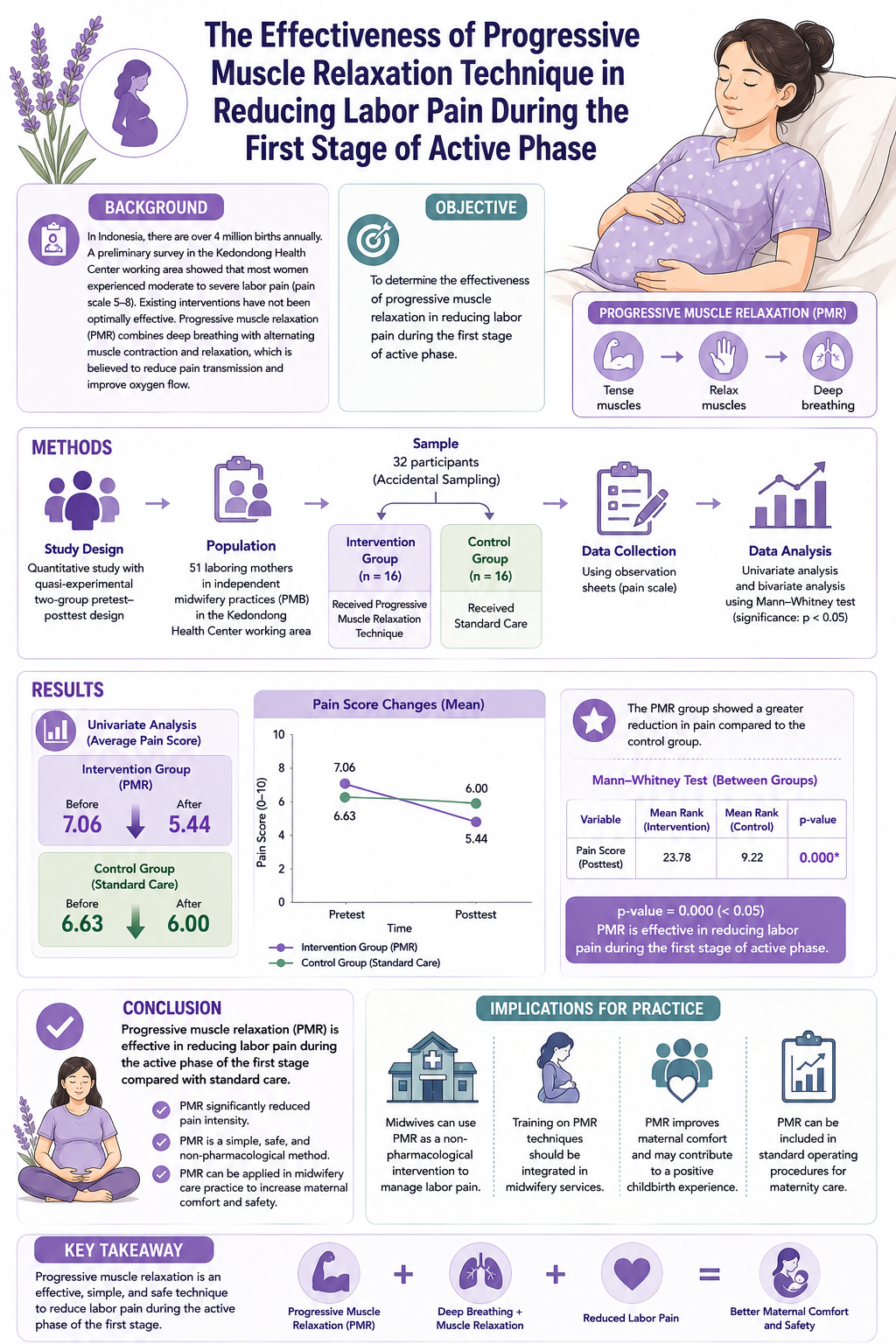
The Effectiveness of Progressive Muscle Relaxation Technique in Reducing Labor Pain During the First Stage of Active Phase

https://doi.org/10.33860/jbc.v8i1.4290
Keywords:
Labor pain, first stage, progressive muscle relaxationAbstract
Background: In Indonesia, there are over 4 million births annually, with 7,503 occurring in Pesawaran District and 720 in Kedondong Public Health Center. A preliminary survey at Kedondong Public Health Center revealed that most women experienced moderate to severe pain (pain scale 5–8). Existing interventions such as breathing techniques, spousal support, and positive suggestions have not been optimally effective in reducing pain. Progressive muscle relaxation (PMR), a non-pharmacological technique combining deep breathing with alternating muscle contraction and relaxation, is believed to reduce pain transmission and improve oxygen flow.
Methods: This quantitative study used a quasi-experimental two-group pretest-posttest design. The population consisted of 51 laboring mothers at independent midwifery practices (PMB) in the Kedondong Health Center working area. A total of 32 participants were selected using accidental sampling and divided equally into intervention and control groups (16 each). Data were collected using observation sheets and analyzed using univariate and bivariate methods (Mann-Whitney test). Results: The univariate analysis showed that the average pain score in the intervention group before the relaxation technique was 7.06 and decreased to 5.44 after the intervention. In the control group, the average pain score before was 6.63 and slightly decreased to 6.00. The results indicated that progressive muscle relaxation was effective in reducing labor pain (p-value = 0.000). Conclusion: Progressive muscle relaxation is effective in reducing labor pain during the active phase of the first stage. Progressive muscle relaxation is applied as a non-pharmacological method to manage labor pain and increase maternal comfort and safety.
Downloads
References
Anuhgera, D. E., Apryanti, Y. P., & Lushinta, L. (2025). Pengaruh Relaksasi Otot Progresif terhadap Rasa Takut pada Persalinan in Primigravida The Effect of Progressive Muscle Relaxation on Fear of Childbirth in Primigravida Mothers. Jurnal Kebidanan Kestra, 8(1), 85–92. Retrieved from https://ejournal.medistra.ac.id/index.php/JKK/article/view/3202
Cecagno, D. (2021). Non-pharmacological therapies applied in pregnancy and labor : an integrative review. Revista Da Escola de Enfermagem Da USP, 55(1), 1–11. Retrieved from https://www.mdpi.com/2077-0383/12/23/7203
Chairani, Y., Intasir, M. P., & Sari, M. P. (2025). Relaxation Techniques for Advancing Women- Centered Childbirth Care. Journal Of Midwifery, 10(2), 57–64. Retrieved from https://jom.fk.unand.ac.id/index.php/jom/article/view/692
Deno, M. K., Bratajaya, C. N. A., & Hidayah. (2022). Efektifitas Relaksasi Otot Progresif terhadap Penurunan Tekanan Darah Tinggi pada Lansia di Paupire , Ende Effectiveness of Progressive Muscle Relaxation on Reducing High Blood Pressure among Elderly in Paupire , Ende. Jurnal Kedokteran MEDITEK, 28(2), 169–176. Retrieved from https://ejournal.ukrida.ac.id/index.php/Meditek/article/view/2309
Frilasari, Heni, H. T. (2020). Penerapan Teknik Relaksasi Progresif Terhadap Derajat Nyeri Persalinan Kala 1 Fase Aktif. Jurnal Keperawatan, 13(1), 7. Retrieved from https://e-journal.lppmdianhusada.ac.id/index.php/jk/article/view/27/21
Guzewicz, P. (2022). The Role of Midwives in the Course of Natural Childbirth — Analysis of Sociodemographic and Psychosocial Factors — A Cross-Sectional Study. Int. J. Environ. Res. Public Health 19(23), 1–16. Retrieved from https://pubmed.ncbi.nlm.nih.gov/36497898/
Heni Frilasari, & Heri Triwibowo. (2020). Penerapan Teknik Relaksasi Progresif Terhadap Derajat Nyeri Persalinan Kala 1 Fase Aktif. Jurnal Keperawatan, 13(1 SE-Articles), 7. Retrieved from https://e-journal.lppmdianhusada.ac.id/index.php/jk/article/view/27
Herlina, L., Wijayanto, W. P., & Amirudin, I. (2024). Penerapan Terapi Relaksasi Otot Progresif Caesarea Di RS Bhayangkara Polda Lampung Tahun. Majalah Cendikia Mengabdi, 2(November), 292–297. Retrieved from https://wpcpublisher.com/jurnal/index.php/majalahcendekiamengabdi/article/view/477
Ju, W., Ren, L., Chen, J. U. N., & Du, Y. (2019). Efficacy of relaxation therapy as an effective nursing intervention for post ‑ operative pain relief in patients undergoing abdominal surgery : A systematic review and meta ‑ analysis. 2909–2916. https://doi.org/10.3892/etm.2019.7915
Khir, S. M., Mohd, W., Wan, A., Yunus, M., Wang, R., Panatik, S. A., … Mahmud, N. (2024). Efficacy of Progressive Muscle Relaxation in Adults for Stress , Anxiety , and Depression : A Systematic Review Efficacy of Progressive Muscle Relaxation in Adults for Stress , Anxiety , and Depression : A Systematic Review. Psychology Research and Behavior Management, 1578, 345–365. https://doi.org/10.2147/PRBM.S437277
lalu muhammad saleh. (2023). ManajeMen Teknik Relaksasi Otot ATC.
Linton, S. J., & Shaw, W. S. (2011). Psychological Control of Acute Pain in Medical Settings Why Psychological Factors Are hnportant. Physical Therapy, 91(5), 700–711. Retrieved from https://academic.oup.com/ptj/article-abstract/91/5/700/2735743?redirectedFrom=PDF
Lowe, N. K., & Lowe, S. (2002). The nature of labor pain. American Journal of Obstetrics and Gynecology, 186(5), 16–24. https://doi.org/10.1067/mob.2002.121427
Made, N., Adhiestiani, E., Ketut, N., Sarini, R., Putu, N., Sri, Y., & Yuliawati, M. (2024). Efektivitas relaksasi otot progresif terhadap tingkat afterpains pasca melahirkan. 18(8), 981–987. Retrieved from https://repository.unar.ac.id/jspui/bitstream/123456789/11063/1/6.%2B492.%2Bonline.pdf
Melaku, L. (2022). Physiological Changes in the Pregnancy and Anesthetic Implication during Labor , Delivery , and Postpartum Abstract : The Open Anesthesia Journal, 16(1), 1–22. https://doi.org/10.2174/25896458-v16-e2207130
Meštrović, A. H., Bilić, M., Lončar, L. B., Mičković, V., & Lončar, Z. (2015). Psychological Factors in Experience of Pain during Childbirth. 557–565. Retrieved from https://hrcak.srce.hr/file/245320
Meyer, H., Lee, N., George, K., & Kearney, L. (2024). Factors influencing midwives ’ intentions to facilitate normal physiological birth : A qualitative study. Women and Birth, 37(4), 101617. https://doi.org/10.1016/j.wombi.2024.101617
Mulyati, Y., Novita, A., & Trisna, N. (2021). Pengaruh Relaksasi Diafragma, Relaksasi Otot Progresif dan Relaksasi Nafas terhadap Penurunan Rasa Cemas pada Ibu Hamil Trimester III. SIMFISIS Jurnal Kebidanan Indonesia, 1(2), 66–77. https://doi.org/10.53801/sjki.v1i2.21
Nasution, S. S., & Ariga, R. A. (2020). Effects of Progressive Muscle Relaxation Technique on Decrease Pain Intensity in Woman During the Latent Phase Delivery. (Icosteerr 2018), 449–453. https://doi.org/10.5220/0010072704490453
Pratamaningtyas, S. (2020). Penerapan Metode Progressive Muscular Relaxation ( Pmr ) Terhadap Nyeri Persalinan Pada Ibu Bersalin Implementation Of Progressive Muscular Relaxation (PMR) Method To Labor Pain On. Jurnal Idaman. 4(2), 71–76. Retrieved from https://ojs.poltekkes-malang.ac.id/idaman/article/download/1536/279
Prawirohardjo. (2020). Ilmu Kebidanan (Yayasan Bina pustaka, ed.). Jakarta: Yayasan Bina Pustaka Sarwono Prawirohardjo.
Sample, D., Abdul, H. M., Diorgu, F. C., & Eleke, C. (2025). Midwives ’ and mothers ’ experiences with non -pharmacological interventions for labour pain relief : A systematic review of evidence generated from qualitative research. 25(1), 1648–1661.
Sinha, M. K., Barman, A., Goyal, M., & Patra, S. (2021). Progressive Muscle Relaxation and Guided Imagery in Breast Cancer : A Systematic Review and Meta-analysis of Randomised Controlled Trials. 27(2), 336–344. https://doi.org/10.25259/IJPC
Tandondo, H. S. (2025). The Effect of Deep Breath Relaxation Techniques on Pain of Labor Phase 1 Active Phase in Mothers Mability at Kolonodale Hospital North Morowali Regency. Health Science & Biomedical Journal (HSBJ) 1(1), 20–27. Retreived from https://linespublishing.com/index.php/hsbj/article/view/4
Downloads
Published
How to Cite
Issue
Section
License
Copyright (c) 2026 Neneng Siti Lathifah , Grestina Yuni Farida Simamora, Anggraini (Author)

This work is licensed under a Creative Commons Attribution-ShareAlike 4.0 International License.
Authors who publish with Jurnal Bidan Cerdas agree to the following terms:
- Authors retain copyright and grant the journal right of first publication with the work simultaneously licensed under a Creative Commons Attribution License (CC BY-SA 4.0) that allows others to share the work with an acknowledgment of the work's authorship and initial publication in this journal.
- Authors are able to enter into separate, additional contractual arrangements for the non-exclusive distribution of the journal's published version of the work (e.g., post it to an institutional repository or publish it in a book), with an acknowledgment of its initial publication in this journal.
- Authors are permitted and encouraged to post their work online (e.g., in institutional repositories or on their website) prior to and during the submission process, as it can lead to productive exchanges, as well as earlier and greater citation of published work.

This work is licensed under a Creative Commons Attribution-Share Alike 4.0 International License
You are free to:
- Share, copy and redistribute the material in any medium or format
- Adapt, remix, transform, and build upon the material for any purpose, even commercially.
- The licensor cannot revoke these freedoms as long as you follow the license terms.