Association of Physical Activity, Depression, Anxiety, and Stress with Menstrual Cycle Regularity among Adolescents: A Cross-Sectional Study

https://doi.org/10.33860/jbc.v8i1.4246
Keywords:
Anxiety, Depression, Menstrual Cycle, Physical Activity, StressAbstract
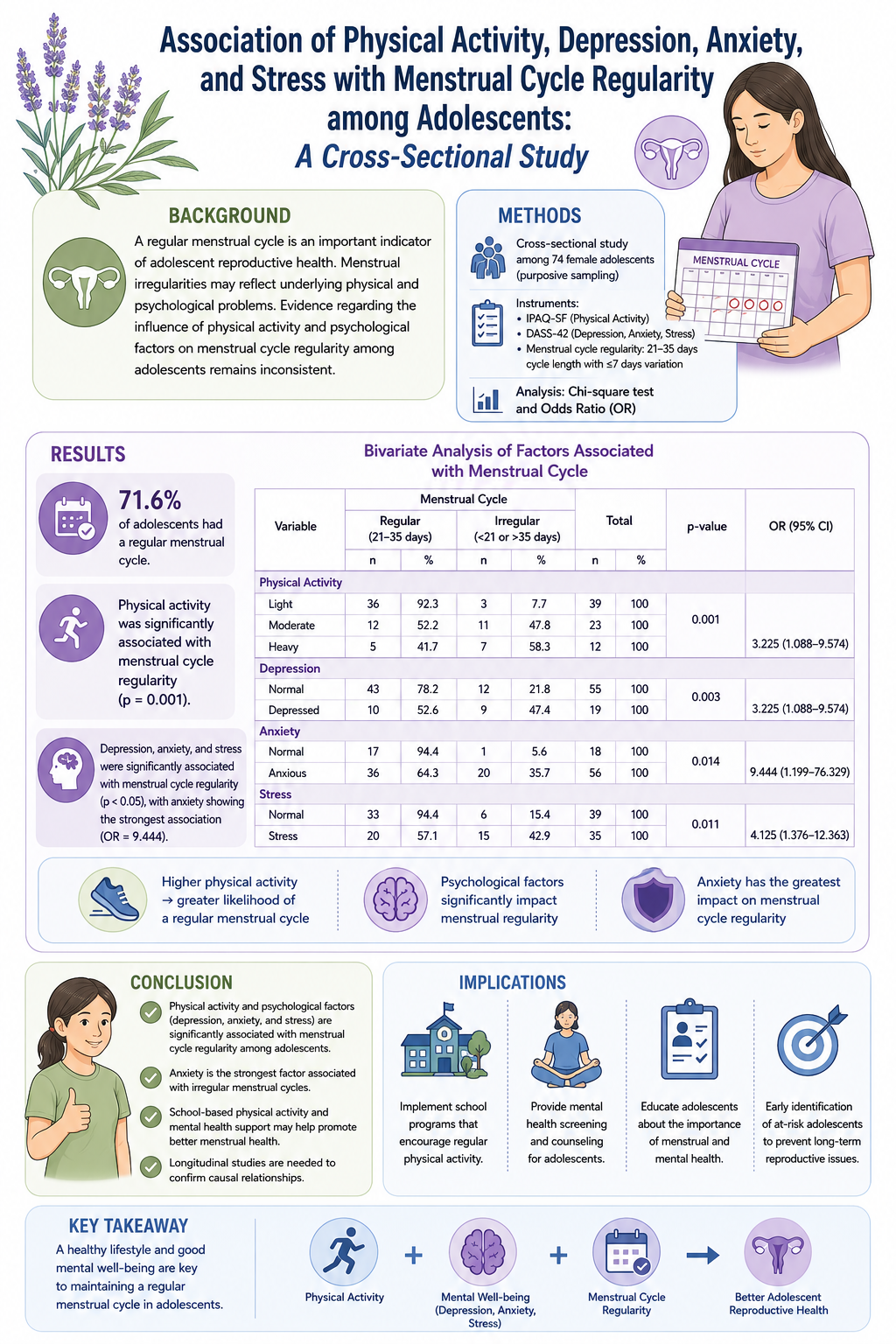
Background: A regular menstrual cycle is an important indicator of adolescent reproductive health. Menstrual irregularities may reflect underlying physical and psychological problems. Evidence regarding the influence of physical activity and psychological factors on menstrual cycle regularity among adolescents remains inconsistent. This study aimed to examine the association of physical activity, depression, anxiety, and stress with menstrual cycle regularity among adolescents.
Methods: A quantitative cross-sectional study was conducted among 74 female adolescents selected through purposive sampling. Inclusion criteria were post-menarche adolescents who consented to participate, while those with a history of congenital gynecological disorders were excluded. Physical activity was measured using the International Physical Activity Questionnaire–Short Form (IPAQ-SF), while depression, anxiety, and stress were assessed using the Depression Anxiety Stress Scale (DASS-42). Menstrual cycle regularity was defined as a cycle length of 21–35 days with ≤7 days variation. Data were analyzed using chi-square tests and odds ratios (OR).
Results: Most respondents (71.6%) had a regular menstrual cycle. Physical activity was significantly associated with menstrual cycle regularity (p = 0.001). Depression, anxiety, and stress were also significantly associated with menstrual cycle regularity (p < 0.05), with anxiety showing the strongest association (OR = 9.444).
Conclusion: Physical activity and psychological factors were significantly associated with menstrual cycle regularity among adolescents, with anxiety as the strongest factor. School-based physical activity and mental health support may help promote menstrual health. Longitudinal studies are needed to confirm causal relationships.
Downloads
References
Abeputri, R., Herlinawati, S. W., & Arifandi, F. (2023). The relationship between anxiety level and menstrual cycle among 11th grade students of Kharisma Bangsa High School and its review from an Islamic perspective. Junior Medical Journal, 1(3), 223–231. https://doi.org/10.33476/jmj.v1i3.2903
Amalia, I. N., Budhiana, J., & Sanjaya, W. (2023). Hubungan stres dengan gangguan siklus menstruasi pada remaja putri. Jurnal Wacana Kesehatan, 8(2), 75. https://doi.org/10.52822/jwk.v8i2.526
Attia, G. M., Alharbi, O. A., & Aljohani, R. M. (2023). The impact of irregular menstruation on health: A review of the literature. Cureus, 15(4), e49146. https://doi.org/10.7759/cureus.49146
Baadiah, M., Winarni, S., Mawarni, A., & Purnami, C. T. (2021). Hubungan aktivitas fisik dan tingkat kecemasan dengan gangguan siklus menstruasi pada mahasiswi. Jurnal Kesehatan Masyarakat (Undip), 9(3), 338–343. https://doi.org/10.14710/jkm.v9i3.29340
Bakhri, K., & Wijayanti, T. (2021). Literature review: Hubungan aktivitas fisik dengan siklus menstruasi pada mahasiswi. Borneo Student Research, 3(1), 405–413. https://journals.umkt.ac.id/index.php/bsr/article/view/2521
Distyvanya, S. A., Nawangsasi, P., Herdiyantini, M., Adiwinoto, R. P., & Setyawan, F. E. B. (2024). Stres dan gangguan siklus menstruasi mahasiswi fakultas kedokteran dan psikologi. CoMPHI Journal: Community Medicine and Public Health of Indonesia Journal, 4(3), 299–304. https://doi.org/10.37148/comphijournal.v4i3.203
Edwards, M. K., & Loprinzi, P. D. (2019). Affective responses to acute bouts of aerobic exercise, mindfulness meditation, and combinations of exercise and meditation: A randomized controlled intervention. Psychological Reports, 122(2), 465–484. https://doi.org/10.1177/0033294118755099
Gao, F., Wei, Z., He, J., Xue, Q., & Huang, M. (2025). The relationship between menstrual issues and depressive and anxiety symptoms in Chinese adolescent female inpatients: A cross-sectional questionnaire-based investigation. BMC Psychology, 13(1), 675. https://doi.org/10.1186/s40359-025-03025-z
Gruber, N., & Modan-Moses, D. (2021). Menstrual cycle in adolescents: Updating the normal pattern. The Journal of Clinical Endocrinology & Metabolism, 106(1), e372–e374. https://doi.org/10.1210/clinem/dgaa688
IBM Corp. (2018). IBM SPSS statistics for Windows (Version 26.0) [Computer software manual]. IBM Corp. https://www.ibm.com/docs/en/SSLVMB_26.0.0/pdf/en/IBM_SPSS_Statistics_Brief_Guide.pdf
Itriyeva, K. (2022). The normal menstrual cycle. Current Problems in Pediatric and Adolescent Health Care, 52(5), 101183. https://doi.org/10.1016/j.cppeds.2022.101183
Kolić, P. V., Sims, D. T., Hicks, K., Thomas, L., & Morse, C. I. (2021). Physical activity and the menstrual cycle: A mixed-methods study of women’s experiences. Women in Sport and Physical Activity Journal, 29(1), 47–58. https://doi.org/10.1123/wspaj.2020-0050
Lolombulan, J. H. (2020). Analisis data statistika bagi peneliti kedokteran dan kesehatan. Penerbit Andi.
Maurya, P., Meher, T., & Muhammad, T. (2022). Relationship between depressive symptoms and self-reported menstrual irregularities during adolescence: Evidence from UDAYA, 2016. BMC Public Health, 22(1), 1–12. https://doi.org/10.1186/s12889-022-13196-8
Mohebi, S., Parham, M., Sharifirad, G., & Gharlipour, Z. (2018). Social support and self-care behavior study. Journal of Education and Health Promotion, 7, 1–6. https://doi.org/10.4103/jehp.jehp
Naila Fauziah, E. (2022). Literature review: Analisis faktor-faktor yang mempengaruhi siklus menstruasi remaja putri. Jurnal Permata Indonesia, 13(2). https://doi.org/10.59737/jpi.v13i2.170
NovoPsych. (2018). Depression anxiety stress scales – 42 (DASS-42). https://novopsych.com
Octavia, Y. T., Astyandini, B., Fitria, N. E., Kusumawardani, E., & Situmorang, S. (2023). Buku ajar asuhan kebidanan pada remaja. Mahakarya Citra Utama.
Park, M., & Jung, S. J. (2021). Association between menstrual cycle irregularity and suicidal ideation among Korean women: Results from the Korea National Health and Nutrition Examination Survey (2010–2012). Journal of Affective Disorders, 293, 279–284. https://doi.org/10.1016/j.jad.2021.06.052
Phumsatitpong, C., Wagenmaker, E. R., & Moenter, S. M. (2021). Neuroendocrine interactions of the stress and reproductive axes. Frontiers in Neuroendocrinology, 63. https://doi.org/10.1016/j.yfrne.2021.100928
Sartika, Y., Nugrahmi, M. A., & Febria, C. (2024). Hubungan indeks massa tubuh (IMT) dengan siklus menstruasi pada siswi kelas VII di MTsN 3 Agam Nagari Balingka. Innovative: Journal of Social Science Research, 4, 509–518. https://j-innovative.org/index.php/Innovative/article/view/7896
Silalahi, V. (2021). Hubungan tingkat kecemasan dengan siklus menstruasi pada mahasiswi tingkat akhir. Jurnal Kesehatan Mercusuar, 4(2), 1–10. https://doi.org/10.36984/jkm.v4i2.213
Siregar, H. S. N., Pane, A. H., Mustika, S. E., & Wardhani, K. (2022). Hubungan kualitas tidur dengan siklus menstruasi pada mahasiswi FK UISU tahun 2021. Jurnal Kedokteran STM (Sains dan Teknologi Medik), 5(2), 101–108. https://doi.org/10.30743/stm.v5i2.319
Sopha, D. M., Haeriyah, S., & STIKes Yatsi Tangerang. (2021). The relationship of stress level and nutritional status with menstrual cycle irregularity in vocational high school adolescents. Nusantara Hasana Journal, 1(2), 1–7. https://ejournal.nusantarahasanajournal.com/index.php/nhj/article/view/40
Sulaeman, R., Purnamawati, D., & Purwana, E. R. (2022). Remaja dan kesehatan reproduksi (H. Widayani, Ed.; 1st ed.). CV Bintang Semesta Media.
Downloads
Published
How to Cite
Issue
Section
License
Copyright (c) 2026 Sunarsih Sunarsih, Ana Mariza, Susilawati Susilawati (Author)

This work is licensed under a Creative Commons Attribution-ShareAlike 4.0 International License.
Authors who publish with Jurnal Bidan Cerdas agree to the following terms:
- Authors retain copyright and grant the journal right of first publication with the work simultaneously licensed under a Creative Commons Attribution License (CC BY-SA 4.0) that allows others to share the work with an acknowledgment of the work's authorship and initial publication in this journal.
- Authors are able to enter into separate, additional contractual arrangements for the non-exclusive distribution of the journal's published version of the work (e.g., post it to an institutional repository or publish it in a book), with an acknowledgment of its initial publication in this journal.
- Authors are permitted and encouraged to post their work online (e.g., in institutional repositories or on their website) prior to and during the submission process, as it can lead to productive exchanges, as well as earlier and greater citation of published work.

This work is licensed under a Creative Commons Attribution-Share Alike 4.0 International License
You are free to:
- Share, copy and redistribute the material in any medium or format
- Adapt, remix, transform, and build upon the material for any purpose, even commercially.
- The licensor cannot revoke these freedoms as long as you follow the license terms.