Impact of Video vs. Leaflet Education on Parents' Knowledge and Attitudes Towards Stunting Prevention

https://doi.org/10.33860/jbc.v8i1.4157
Keywords:
health education, video, leaflet, father and mother, stuntingAbstract
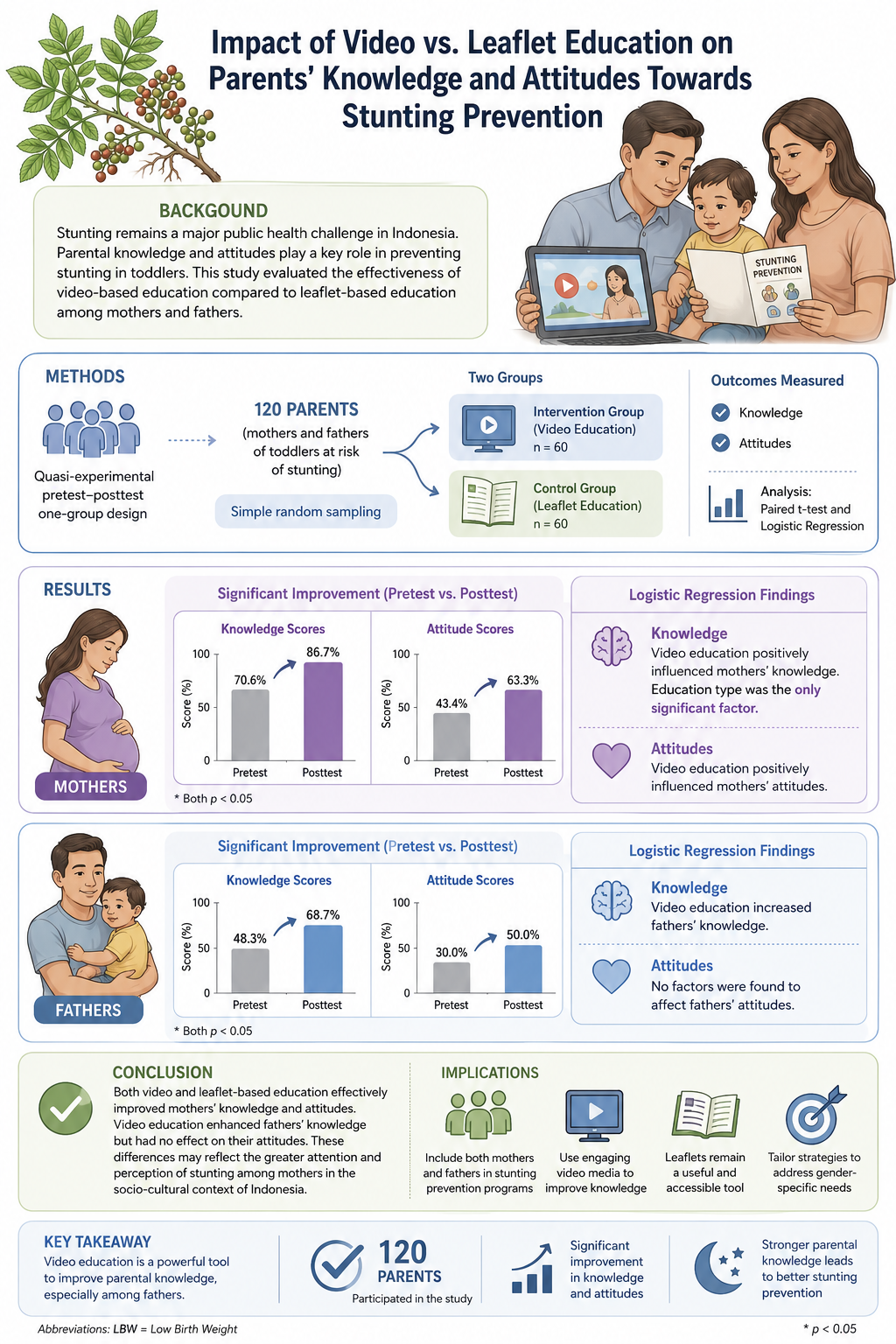
Background: Stunting is a significant health challenge, leading to health issues and impaired cognitive development in children, affecting the nation’s future human resources. While various educational interventions have been implemented, no evaluation has compared the effectiveness of different media for parents. This study aimed to evaluate the effectiveness of video and leaflet-based education for mothers and fathers of toddlers at risk of stunting.
Methods: A quasi-experimental pretest-posttest one-group design was used. The sample consisted of 120 parents, divided into an intervention group (video) and a control group (leaflet), selected by simple random sampling. Multiple regression analysis was created to examine the association.
Results: Significant pretest-posttest improvements in knowledge and attitudes were observed in both parents (p <0.05). Logistic regression analysis showed that video-based education positively influenced mothers' knowledge and attitudes, with education type being the only significant factor affecting mothers' knowledge. In fathers, video-based education increased knowledge, but no factors were found to affect attitudes.
Conclusion: Both video and leaflet-based education effectively improved mothers' knowledge and attitudes. Video education enhanced fathers' knowledge but had no effect on their attitudes. These differences may reflect the greater attention and perception of stunting among mothers in the socio-cultural context of Indonesia.
Downloads
References
Arywiantari, D., Agung, A. A. G., & Tastra, I. D. K. (2015). Pengembangan multimedia interaktif model 4D pada pembelajaran IPA di SMP Negeri 3 Singaraja jurusan teknologi pendidikan universitas pendidikan ganesha. 3(c), 1–12.
Badan Pusat Statistik. (2022). profil-kesehatan-ibu-dan-anak-2022.
Danuri, M. (2019). Development and transformation of digital technology. Infokam, XV(II), 116–123.
Deng, W. J., Yi, Z., & Lee, J. C. K. (2024). The Demographic Variation in Nutrition Knowledge and Relationship with Eating Attitudes among Chinese University Students. International Journal of Environmental Research and Public Health, 21(2). https://doi.org/10.3390/ijerph21020159
Djaafar, T., & Novarianti, A. (2024). Peningkatan Pengetahuan dan Sikap Ibu Balita Dengan Media Leaflet Tentang Stunting Increasing Knowledge and Attitudes of Mothers of Toddlers with Leaflet Media About Stunting. JURNAL PROMOTIF PREVENTIF, 7(2), 205–210. https://doi.org/https://doi.org/10.47650/jpp.v7i2.1210
Fitriami, E., & Galaresa, A. V. (2022). Edukasi Pencegahan Stunting Berbasis Aplikasi Android Dalam Meningkatkan Pengetahuan Dan Sikap Ibu STIKes Pekanbaru Medical Center * Email : elfizafitriamy26@gmail.com Android Application-Based Stunting Prevention Education in Increasing Mother ’ s Knowle. Jurnal Ilmiah STIKES, 5(2), 78–85.
Hadi, H., Nurunniyah, S., Gittelsohn, J., Alfiana, R. D., Fatimatasari, Lewis, E. C., & Nurdiati, D. (2023). Preconception Maternal Mentoring for Improved Fetal Growth among Indonesian Women: Results from a Cluster Randomized Controlled Trial. Nutrients, 15(21). https://doi.org/10.3390/nu15214579
Hati, F. S., & Pratiwi, A. M. (2019). The Effect of Education Giving on The Parent’s Behavior About Growth Stimulation in Children with Stunting. NurseLine Journal, 4(1), 12. https://doi.org/10.19184/nlj.v4i1.8628
Hidayati, L., Hadi, H., & Kumara, A. (2010). Kekurangan Energi Dan Zat Gizi Merupakan Faktor Risiko Kejadian Stunted Pada Anak Usia 1-3 Tahun Yang. Jurnal Kesehatan, 3(1), 89–104. https://publikasiilmiah.ums.ac.id/bitstream/11617/2315/1/10.%20LISTYANI%20H.pdf
Indonesian Ministry of Health. (2021). Buku Saku Hasil SSGI 2021.
Indonesian Ministry of Health. (2023). Hasil Survei Status Gizi Indonesia (SSGI) 2022. Kemenkes, 1–7.
Indonesian Ministry of Health. (2025). Survei Status Gizi Indonesia 2024 Dalam Angka.
Karim, H. A. (2020). Health literacy among rural communities: Issues of accessibility to information and media literacy. Jurnal Komunikasi: Malaysian Journal of Communication, 36(1), 248–262. https://doi.org/10.17576/JKMJC-2020-3601-14
Kyaw, B. M., Posadzki, P., Paddock, S., Car, J., Campbell, J., & Tudor Car, L. (2019). Effectiveness of digital education on common unication skills among medical students: Systematic review and meta-analysis by the digital health education collaboration. Journal of Medical Internet Research, 21(8). https://doi.org/10.2196/12967
Lestari, R. A., & Sefrina, L. R. (2024). Efektivitas Penggunaan Media Leaflet Dengan Tingkat Pengetahuan Dan Sikap Ibu Mengenai Stunting. https://doi.org/https://doi.org/10.31004/prepotif.v9i2.46054
Marni, M., Soares, D., Wahyudi, T., Irfan, M., & Nurul, S. (2022). Analysis Stunting Prevention and Intervention: A Literatur Review. Proceedings of the International Conference on Nursing and Health Sciences, 3(1), 27–36. https://doi.org/10.37287/picnhs.v3i1.1110
Nisa’, H., Mutiara Puspitarini, L., & Lu’lu’ Zahrohti, M. (2022). Perbedaan Peran Ibu dan Ayah dalam Pengasuhan Anak pada Keluarga Jawa. In Jurnal Multidisiplin West Science (Vol. 01, Issue 02). Desember.
Paramita, L. D. A., Devi, N. L. P. S., & Nurhesti, P. O. Y. (2021). Hubungan Pengetahuan Dan Sikap Ibu Mengenai Stunting Dengan Kejadian Stunting Di Desa Tiga, Susut, Bangli. Coping: Community of Publishing in Nursing, 9(3), 323. https://doi.org/10.24843/coping.2021.v09.i03.p11
Putri, A. N., Dewi, Y. L. R., & Priyatama, A. N. (2023). Factors Associated with Stunting in Adolescentsin Pariaman, Padang, West Sumatera, Indonesia. Journal of Maternal and Child Health, 8(4), 421–428. https://doi.org/10.26911/thejmch.2023.08.04.04
Rahayu, M., Meidya Pratiwi, A., Subarto, C. B., Ayuningrum, L. D., Lestari, P., & Nurhayati, E. (2024). Pengetahuan Ibu tentang Stimulasi Berhubungan dengan Perkembangan Balita Usia 3-5 Tahun. In Arantika Meidya Pratiwi, dkk) Jurnal Dunia Kesmas (Vol. 13, Issue 2). Online. http://ejurnalmalahayati.ac.id/index.php/duniakesmas/index
Rohmalina, R., Suryono, Y., & Fauziah, P. Y. (2021). The Role of the Father in the Early First Year of Early Childhood’s Life. Digital Press Social Sciences and Humanities, 7, 00015. https://doi.org/10.29037/digitalpress.47405
Sary, M. P., & Turnip, S. S. (2015). Attitude Difference between Fathers and Mothers toward Fathers Involvement in Child Rearing Activities among Couples with 0-12 Months Old Babies. Community based Study in a Primary Health Care Setting. Procedia - Social and Behavioral Sciences, 190, 92–96. https://doi.org/10.1016/j.sbspro.2015.04.921
Sitorus, S. B. M., Sasmita, H., & Lailatul K., M. F. (2024). Health Education Influences Mother’s Knowledge in Preventing Stunting in Infants. Jurnal Bidan Cerdas, 6(1), 19–26. https://doi.org/10.33860/jbc.v6i1.3266
Sommer, L. (2011). The Theory Of Planned Behaviour And The Impact Of Past Behaviour. International Business & Economics Research Journal (IBER), 10(1), 91–110. https://doi.org/10.19030/iber.v10i1.930
Sukmawati, S., Hermayanti, Y., Fadlyana, E., & Mediani, H. S. (2021). Stunting prevention with education and nutrition in pregnant women: A review of literature. Open Access Macedonian Journal of Medical Sciences, 9(T6), 12–19. https://doi.org/10.3889/oamjms.2021.7314
Syahputra Bukit, D., Keloko, A. B., & Ashar, T. (2021). Father’s Support and Mother’s Behavior in Stunting Prevention Efforts. https://doi.org/10.29080/jhsp.v5i1.521
Wahyuningsih, W., Bukhari, A., Juliaty, A., Erika, K. A., Pamungkas, R. A., Siokal, B., Saharuddin, S., & Amir, S. (2022). Stunting Prevention and Control Program to Reduce the Prevalence of Stunting: Systematic Review Study. Open Access Macedonian Journal of Medical Sciences, 10(F), 190–200. https://doi.org/10.3889/oamjms.2022.8562
Warsini, K. T., Hadi, H., & Nurdiati, D. S. (2016). Riwayat KEK dan anemia pada ibu hamil tidak berhubungan dengan kejadian stunting pada anak usia 6-23 bulan di Kecamatan Sedayu, Bantul, Yogyakarta. Jurnal Gizi Dan Dietetik Indonesia (Indonesian Journal of Nutrition and Dietetics). https://doi.org/10.21927/ijnd.2016.4(1).29-40
Wulandari, H. W., & Kusumastuti, I. (2020). Pengaruh Peran Bidan, Peran Kader, Dukungan Keluarga dan Motivasi Ibu terhadap Perilaku Ibu dalam Pencegahan Stunting pada Balitanya. Jurnal Ilmiah Kesehatan, 19(02), 73–80. https://doi.org/10.33221/jikes.v19i02.548
Downloads
Published
How to Cite
Issue
Section
License
Copyright (c) 2026 Siti Fatimah, Arantika Meidya Pratiwi, Arif Sabta Aji, Hamdhoona Abdullah, Siti Nurunniyah (Author)

This work is licensed under a Creative Commons Attribution-ShareAlike 4.0 International License.
Authors who publish with Jurnal Bidan Cerdas agree to the following terms:
- Authors retain copyright and grant the journal right of first publication with the work simultaneously licensed under a Creative Commons Attribution License (CC BY-SA 4.0) that allows others to share the work with an acknowledgment of the work's authorship and initial publication in this journal.
- Authors are able to enter into separate, additional contractual arrangements for the non-exclusive distribution of the journal's published version of the work (e.g., post it to an institutional repository or publish it in a book), with an acknowledgment of its initial publication in this journal.
- Authors are permitted and encouraged to post their work online (e.g., in institutional repositories or on their website) prior to and during the submission process, as it can lead to productive exchanges, as well as earlier and greater citation of published work.

This work is licensed under a Creative Commons Attribution-Share Alike 4.0 International License
You are free to:
- Share, copy and redistribute the material in any medium or format
- Adapt, remix, transform, and build upon the material for any purpose, even commercially.
- The licensor cannot revoke these freedoms as long as you follow the license terms.