Employment Status as a Predictor of Breastfeeding Self-Efficacy

https://doi.org/10.33860/jbc.v8i1.3897
Keywords:
Employment Status, Breastfeeding Self-EfficacyAbstract
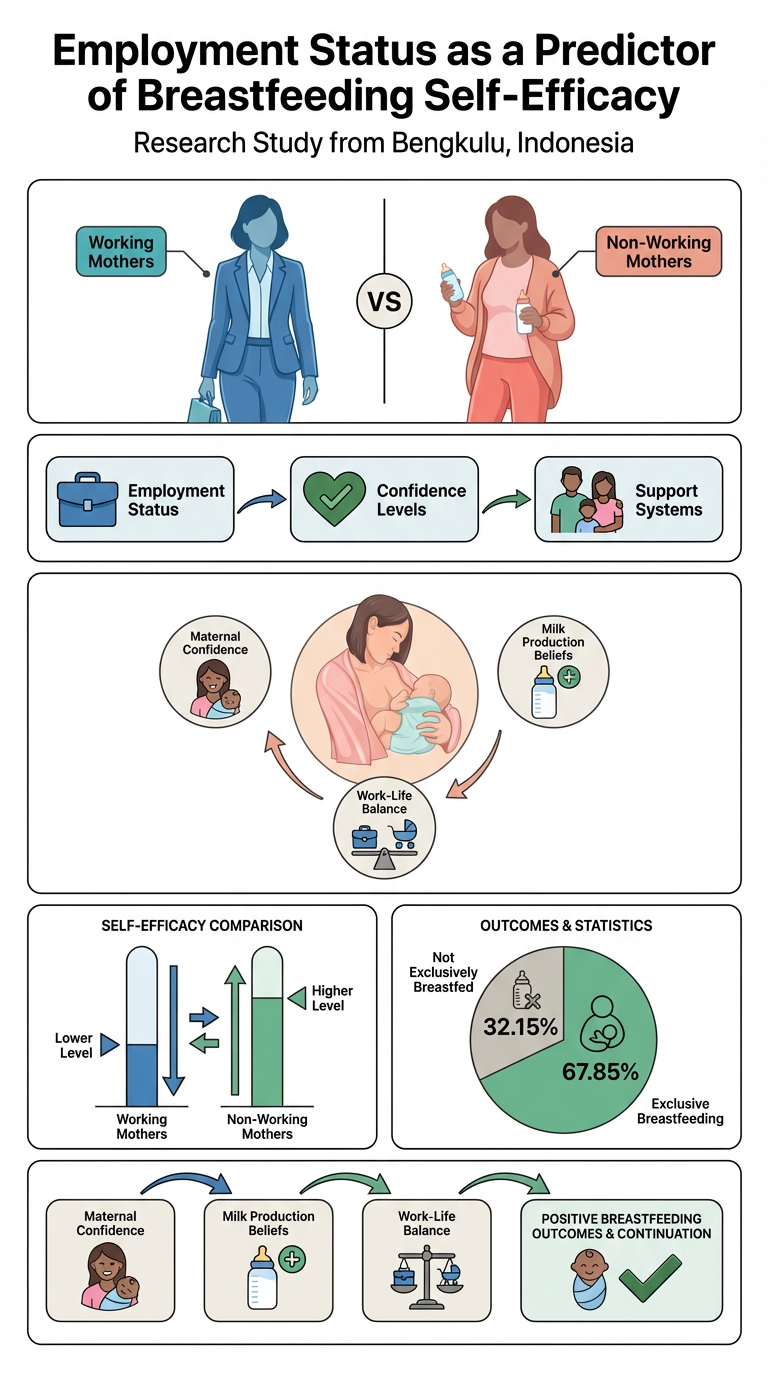
Background: In Indonesia, the percentage was 71.58% in 2021, and in the Province of Bengkulu in 2022, 67.85% of babies aged 0-5 months received exclusive breast milk. Around 32.15% of babies are still not breastfed. Breastfeeding with high self-confidence to successfully breastfeed their babies (breastfeeding self-efficacy) will influence the success of exclusive breastfeeding. The mother’s belief that her breast milk production is inadequate or little, which leads to worries that it won’t be sufficient to satisfy the baby’s demands, is the issue with not providing exclusive breastfeeding. This study aimed to identify factors that predict breastfeeding self-efficacy. Methods: The research design uses a cross-sectional analytical survey. The study population comprised 556 respondents, selected from a 100-person sample using the inclusion and exclusion criteria. The research period is from May to November 2024. Data collection uses a questionnaire with the BSES-SF. Data analysis uses discriminant analysis. Results:.The research results on the variables age (0.442), education (0.406), parity (0.575), ANC visits (0.165), and breastfeeding status (0.455), so there is no different in average age, education, parity, ANC visits, and breastfeeding status between self-efficacy in low and high breastfeeding mothers, while the working status variable has a p-value of 0.025, so there is a difference in the average working status between low and high self-efficacy. Conclusion: Mothers' working status as a predictor of breastfeeding self-efficacy.
Downloads
References
Ahmad, M., Beheshti, Z., Alimoradi, Z., Bahrami, N., & Allen, K. (2020). Predictors of breastfeeding self-efficacy during the covid-19 pandemic. Elseiver, January. https://pmc.ncbi.nlm.nih.gov/articles/PMC9425044/
Amer, S., & Kateeb, E. (2023). Mothers’ Employment and Exclusive Breastfeeding Practices: A Brief Report from Jerusalem Governorate. International Journal of Environmental Research and Public Health, 20(3). https://doi.org/10.3390/ijerph20032066. https://pubmed.ncbi.nlm.nih.gov/36767434/
Angio, M. C., & Sukesi. (2018). Pengaruh Peer Education Terhadap Self Efficacy Dan Motivasi the Effect of Peer Education on Self Efficacy and Motivation in Breastfeeding Mother in Giving Breastmilk. Jurnal Ilmu Keperawatan Komunitas, 2(1), 26–32. https://journal.ppnijateng.org/jikk/id/article/view/302
Awaliyah, S. N., Rachmawati, I. N., & Rahmah, H. (2019). Breastfeeding self-efficacy as a dominant factor affecting maternal breastfeeding satisfaction. BMC Nursing, 18(Suppl 1), 1–7. https://doi.org/10.1186/s12912-019-0359-6. https://pubmed.ncbi.nlm.nih.gov/31427892/
Ayuningtyas, B. Y. O., & Oktanasari, W. (2023). Pengaruh Efikasi Diri Ibu Menyusui Dengan Pemberian Asi Eksklusif Di Rsu Aghisna Medika Kroya. Jurnal Bina Cipta Husada: Jurnal Kesehatan Dan Science, 19(1), 124–135. https://jurnal.stikesbch.ac.id/index.php/jurnal/article/view/97
Chumaira, R. L., Anggorowati, A., & Zubaidah, Z. (2024). Faktor-faktor yang mempengaruhi efikasi diri ibu dan praktik menyusui di kalangan ibu yang bekerja: A literature review. Holistik Jurnal Kesehatan, 18(1), 26–35. https://garuda.kemdiktisaintek.go.id/documents/detail/4033314
Corby, K., Kane, D., & Dayus, D. (2021). Investigating Predictors of Prenatal Breastfeeding Self-Efficacy. The Canadian Journal of Nursing Research = Revue Canadienne de Recherche En Sciences Infirmieres, 53(1), 56–63. https://doi.org/10.1177/0844562119888363. https://journals.sagepub.com/doi/abs/10.1177/0844562119888363?__cf_chl_f_tk=5IC7JzFzsPfyWxKQ_HGF5qcXNkkoD_sTQr_OgisiNOI-1782944768-1.0.1.1-lH6q025s6izFCIzvK8M77uO3UNRwTqT.t7xwSl9vtUU
Diah, M., Putri, R. A., & Fikitina. (2022). Relationship of Age and Parity With Breastfeeding Self Efficacy for Post Partum Mothers. Indonesian Journal of Midwifery (IJM), 5(1), 84–89. https://jurnal.unw.ac.id/index.php/ijm/article/view/1543
Erick, M. (2018). Breast milk is conditionally perfect. Medical Hypotheses, 111(December), 82–89. https://doi.org/10.1016/j.mehy.2017.12.020. https://www.sciencedirect.com/science/article/abs/pii/S0306987717306497
Gonzales, A. M. (2020). Breastfeeding self-efficacy of early postpartum mothers in an urban municipality in the Philippines. Asian Pacific Island Nursing Journal, 4(4), 135–143. https://doi.org/10.31372/20190404.1023. https://pmc.ncbi.nlm.nih.gov/articles/PMC7014381/
Gonzales Jr, A. M. (2020). Breastfeeding self-efficacy of early postpartum mothers in an urban municipality in the Philippines. Asian/Pacific Island Nursing Journal, 4(4), 135. https://pmc.ncbi.nlm.nih.gov/articles/PMC7014381/
Kemenkes RI. (2020). Pedoman Pelayanan Antenatal Terpadu 2020 Ed.3. In Kementerian Kesehatan Republik Indonesia: Vol. III (Issue 3). https://repository.kemkes.go.id/book/147
Li, L., Wu, Y., Wang, Q., Du, Y., Friesen, D., Guo, Y., Dill, S. E., Medina, A., Rozelle, S., & Zhou, H. (2022). Determinants of breastfeeding self-efficacy among postpartum women in rural China: A cross-sectional study. PLoS ONE, 17(4 April), 1–18. https://doi.org/10.1371/journal.pone.0266273
Mahayati, N. M. D., Dewi, I. G. A. A. N., Tirtawati, G. A., Astiti, N. K. E., & Purnamayanti, N. M. D. (2024). Hubungan Umur dan Paritas dengan Breastfeeding Self Efficacy Ibu Nifas. Ghidza: Jurnal Gizi Dan Kesehatan, 8(1), 68–73. https://jurnal.fkm.untad.ac.id/index.php/ghidza/article/view/1217
Mariana, D., & Idayati, I. (2022). Analisis Faktor yang Berhubungan dengan Efikasi Diri Menyusui. Jurnal Bidan Cerdas, 4(4), 214–223.
Melo, L. C. de O., Bonelli, M. C. P., Lima, R. V. A., Gomes-Sponholz, F. A., & Monteiro, J. C. D. S. (2021). Anxiety and its influence on maternal breastfeeding self-efficacy. Revista Latino-Americana de Enfermagem, 29, e3485. https://doi.org/10.1590/1518-8345.5104.3485
Mercan, Y., & Selcuk, K. T. (2021). Association between postpartum depression level, social support level and breastfeeding attitude and breastfeeding self-efficacy in early postpartum women. PLoS ONE, 16(4 April 2021), 1–12. https://doi.org/10.1371/journal.pone.0249538
Okbay Güneş, A., Karadağ, N., & Karatekin, G. (2023). The Effect of Breastfeeding Self-Efficacy on Infants’ Weights and Breastfeeding Outcomes. Turkish Archives of Pediatrics, 58(6), 588–593. https://doi.org/10.5152/TurkArchPediatr.2023.23113
Oktafia, R., Rahmayanti, R., Maghpira, D. A., & Indriastuti, N. A. (2022). Psychosocial Condition and Parenting Self-Efficacy Among Postpartum Mothers. Jurnal Aisyah : Jurnal Ilmu Kesehatan, 7, 241–246. https://doi.org/10.30604/jika.v7iS2.1435
Piccolo, O., Kinshella, M. L. W., Salimu, S., Vidler, M., Banda, M., Dube, Q., Kawaza, K., Goldfarb, D. M., & Nyondo-Mipando, A. L. (2022). Healthcare worker perspectives on mother’s insufficient milk supply in Malawi. International Breastfeeding Journal, 17(1), 1–9. https://doi.org/10.1186/s13006-022-00460-1
Pratama, R. M. K., Handayani, A. M., Andriani, L., Yunus, A., & Novika, R. G. H. (2023). Herbal galactogogue supplementation on average zinc and iron levels in breast milk. International Journal of Public Health Science (IJPHS), 12(4), 1586–1593. https://doi.org/10.11591/ijphs.v12i4.22839
Pratama, R. S. P., Dasuki, M. S., Agustina, T., & Soekiswati, S. (2022). ASI Eksklusif Sebagai Faktor Protektif Terhadap Kejadian Stunting Pada Balita. Jurnal Ilmiah Kesehatan Sandi Husada, 1, 262–270. https://www.researchgate.net/publication/361010874_ASI_Eksklusif_Sebagai_Faktor_Protektif_Terhadap_Kejadian_Stunting_Pada_Balita_24-59_Bulan?__cf_chl_f_tk=KgdaMPHYXHTZ5mAp_fEasuSve7NIchXO6CvRs0Ai9Lk-1782945025-1.0.1.1-pexAy9SXt4a6QlO7ypLrN_oU8U9n1fFKf21V7U3l2uw
Sabilla, M., & Rr. Arum Ariasih. (2022). Analisis Breastfeeding Self-efficacy pada Ibu Menyusui. Jurnal Semesta Sehat (J-Mestahat), 2(1), 11–18. https://doi.org/10.58185/j-mestahat.v2i1.84
Shiraishi, M., Matsuzaki, M., Kurihara, S., Iwamoto, M., & Shimada, M. (2020). Post-breastfeeding stress response and breastfeeding self-efficacy as modifiable predictors of exclusive breastfeeding at 3 months postpartum: a prospective cohort study. BMC Pregnancy and Childbirth, 20(1), 1–10. https://doi.org/10.1186/s12884-020-03431-8
Statistik, B. P. (2022). Survei Sosial dan ekonomi Nasional (Susenas) Tahun 2022. https://silastik.bps.go.id/v3/index.php/mikrodata/detail/QS91WmNDbmhEWldHa3RFSU9vZGthZz09
Wijaya, F. A. (2019). ASI Eksklusif : Nutrisi Ideal untuk Bayi 0-6 Bulan. Cdk-275, 46(4), 296–300. https://cdkjournal.com/index.php/CDK/article/view/485
Wu, S. F. V., Chen, S. C., Liu, H. Y., Lee, H. L., & Lin, Y. E. (2021). Knowledge, intention, and self-efficacy associated with breastfeeding: Impact of these factors on breastfeeding during postpartum hospital stays in taiwanese women. International Journal of Environmental Research and Public Health, 18(9). https://doi.org/10.3390/ijerph18095009
Zulkarnaini, Z., Hernita, H., & Ardilla, A. (2023). The Relationship Between Breastfeeding Self-Efficacy and The Success of Exclusive Breastfeeding. JIKO (Jurnal Ilmiah Keperawatan Orthopedi), 7(1), 1–7. https://doi.org/10.46749/jiko.v7i1.121
Downloads
Published
How to Cite
Issue
Section
License
Copyright (c) 2026 Rini Mustikasari Kurnia Pratama, Damayanti (Author)

This work is licensed under a Creative Commons Attribution-ShareAlike 4.0 International License.
Authors who publish with Jurnal Bidan Cerdas agree to the following terms:
- Authors retain copyright and grant the journal right of first publication with the work simultaneously licensed under a Creative Commons Attribution License (CC BY-SA 4.0) that allows others to share the work with an acknowledgment of the work's authorship and initial publication in this journal.
- Authors are able to enter into separate, additional contractual arrangements for the non-exclusive distribution of the journal's published version of the work (e.g., post it to an institutional repository or publish it in a book), with an acknowledgment of its initial publication in this journal.
- Authors are permitted and encouraged to post their work online (e.g., in institutional repositories or on their website) prior to and during the submission process, as it can lead to productive exchanges, as well as earlier and greater citation of published work.

This work is licensed under a Creative Commons Attribution-Share Alike 4.0 International License
You are free to:
- Share, copy and redistribute the material in any medium or format
- Adapt, remix, transform, and build upon the material for any purpose, even commercially.
- The licensor cannot revoke these freedoms as long as you follow the license terms.